
Back Band Window Casing — Add a Back Band to Flat Casing
Your flat window casing looks thin against the baseboard and the doors. A back band around the outside edge makes it read as heavy, built-up trim without tearing anything off the wall.
Back band window casing is flat casing with a second, thicker molding, the back band, wrapped around its outside edge. It turns plain 1x4 trim into a built-up profile that stands off the wall with a shadow line. JMB Builders adds a back band to existing flat casing or builds new back band window casing across the Twin Cities metro, mitered at the head, stopped at the stool horns, caulked. Priced per window, quoted from photos within one business day.
- Priced per window; existing flat casing can stay
- Back band added to old casing or new casing built up
- Quote from photos in 1 business day
- Licensed MN contractor BC809005
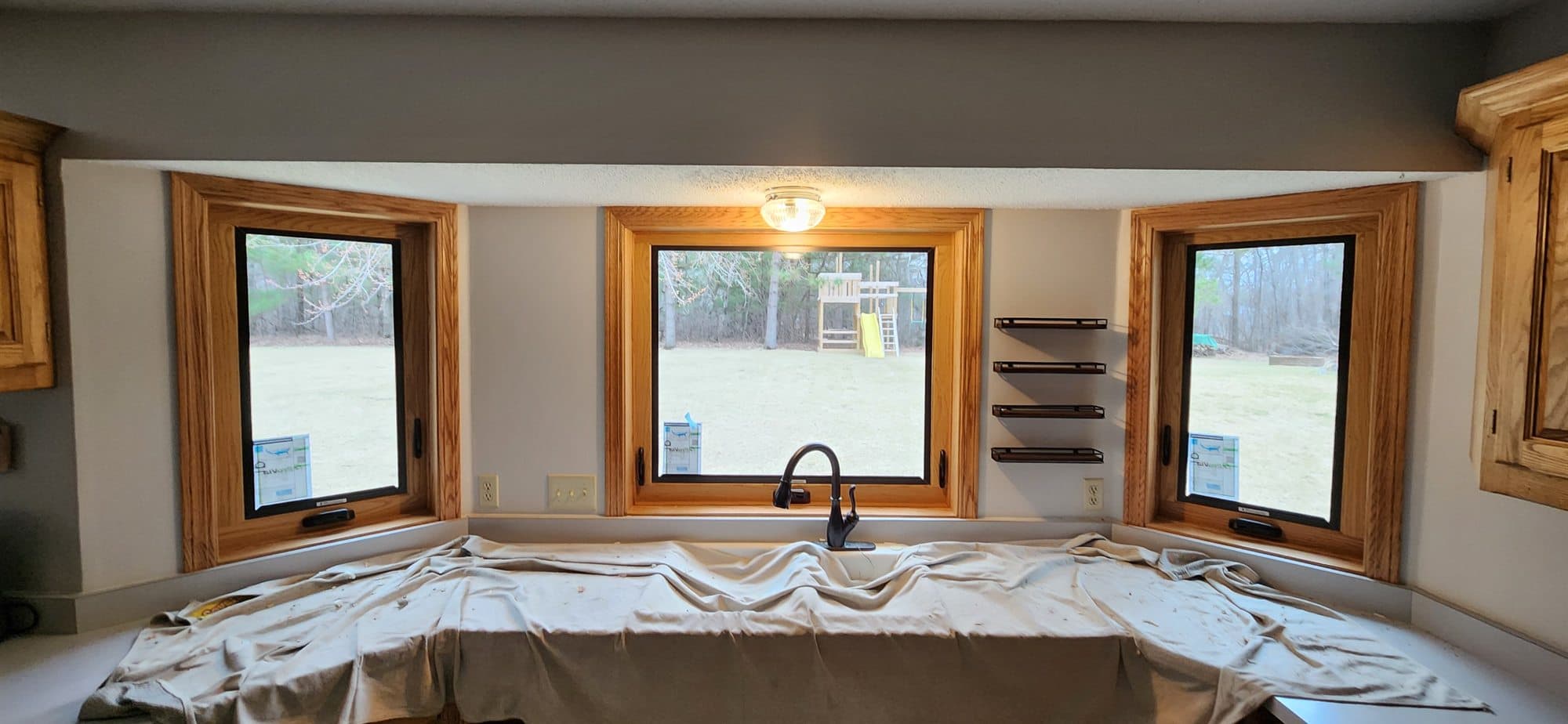
A back band is a small L-shaped molding with a rabbet cut in the back. The rabbet hooks over the outside edge of flat casing, so the band sits proud of the board and covers its edge. That is how most of the heavy trim in older Twin Cities houses was made: a plain flat board plus a back band, not one wide milled profile. The band is what gives the casing its thickness and its shadow line.
People ask for it for two reasons. The first is that flat 1x4 casing on its own looks thin, especially next to a tall baseboard or a door with heavier trim. The second is a baseboard that is thicker than the casing, so the base runs into the side of the window trim and sticks out past it. A back band fixes both: the casing gets thicker than the base, and the base dies into the band the way it should.
JMB Builders adds back band to window casing across the Twin Cities metro. On existing flat casing the band goes on over what is there, mitered at the two head corners and run down the legs to the stool. The stool horns have to stick out past the band, so if the existing horns are short we extend them or cut a new stool. On a bare window we build the whole thing: jamb extensions, flat casing, back band, stool and apron. Painting or staining is quoted as a separate line, or leave it primed and caulked and paint it yourself.
What you supply
- Photos of one window straight on, plus a close-up where the baseboard meets the casing
- Your choice of back band profile from the samples we bring, or a piece of the profile you want matched
- Paint or stain color if you want us to finish it; painting is quoted as a separate line, or paint it yourself
What JMB supplies
- Back band stock in primed pine, poplar or MDF for paint, or oak, maple or another species for stain
- A rabbet that fits your casing thickness, ripped on site when the stock band does not match
- Mitered head corners, glued and pinned so they stay closed through the heating season
- Stool horn extensions or a new stool when the existing horns are too short for the band
- Flat casing, jamb extensions, stool and apron on windows that are bare or getting all new trim
- Nail holes filled, joints caulked, ready for paint
- Painting or staining of the new trim when you want it done, quoted as its own line
- Photos of the finished windows in your job folder
How it is priced: per window
Quoted in writing from your photos within one business day. What moves the number:
- Band added over existing flat casing vs. new built-up casing on a bare window
- Whether the stool horns have to be extended or the stool replaced
- Paint-grade band vs. stain-grade in a matching species
- A stock back band profile vs. one ripped or milled to match old trim
- Doors done in the same visit so the whole room matches; the second opening is cheaper than the first
- Whether the baseboard has to be recut where it meets the thicker casing
Send a photo of the profile you like, or a photo of a window in your house that already has a band, and the quote is firm with no allowances.
How long it takes
Back band on existing casing: six to ten windows in a day. New built-up casing from a bare window: two to four windows a day. Painting adds drying time between coats.
How your project works
- 1
Send photos, get a written quote
Send three photos of the space and a sentence about what you want. You get a clear, itemized quote within one business day. We only come out to measure first when the job needs a tape measure — no pressure, no games.
- 2
Pick materials, or bring your own
We help you choose profiles and materials that fit the house and the budget, or match your existing millwork exactly — or you buy the door or trim yourself and we install it. Everything is confirmed before the crew is scheduled.
- 3
Clean, precise installation
The crew shows up on time, protects floors and furniture, and installs with tight joints and consistent reveals. Photos of the finished work go in your job folder.
- 4
Walkthrough and invoice
We walk the finished work with you. If anything is not right, we fix it before we call the job done. Then one invoice, paid by check or direct deposit — no card fees, no payment links.
Situations and options
Back band over existing flat casing
The casing stays. We check it is flat and tight to the wall, hook the band over its outside edge, miter the two top corners and stop the legs at the stool horns. The fastest way to make thin trim look heavy.
New built-up casing on a bare window
Jamb extensions, flat 1x4 or 1x6 casing, back band, a 5/4 stool with horns cut long enough to clear the band, and an apron. The full traditional build-up on a drywall-return or replacement window.
Back band with a head cap
The band runs up the legs and across the head, and a small cap molding sits on top of the head for a heavier crown. Common on 1910s to 1930s Twin Cities houses and easy to match with stock pieces.
Stain-grade back band
Oak, maple, birch or fir band on matching flat casing, sanded and left ready for stain. Miters are cut tight because there is no caulk to hide behind. Staining is quoted as its own line.
Back Band Window Casing — Add a Back Band to Flat Casing: questions, answered
What is a back band on window casing?
A back band is a narrow molding with a rabbet, a notch cut along the back, that hooks over the outside edge of flat casing. It stands proud of the casing and makes the whole trim thicker and wider. Most old built-up window trim is a flat board with a back band around it, not one wide milled profile.
Can you add a back band to the window trim I already have?
Yes, if the casing is flat stock with a square outside edge. The band hooks over that edge and nails through it into the wall framing. Profiled casing with a shaped edge does not take a band; that trim comes off and flat casing goes on first. Send a close-up of the edge of your casing and we will tell you which one you have.
Why does my baseboard stick out past the window and door casing?
Because the base is thicker than the casing. Baseboard is supposed to die into the casing, which means the casing has to be the thicker of the two. A back band makes the casing thicker than almost any baseboard, so the base butts into the band cleanly. We recut the ends of the base where it meets the new band.
Does a back band work with a window stool?
Yes, but the stool horns have to stick out past the band. On a window with a stool, the band runs down each leg and stops on top of the horn. If the horns were cut for plain casing they will be too short, so we either glue on an extension and shape it, or cut a new stool. On a picture-frame window the band goes around all four sides and there is no stool to worry about.
Should the doors get a back band too?
Usually. A room where the windows have heavy built-up casing and the doors have thin flat casing looks unfinished. The same band goes on the door casing with a miter at the top corners and a plinth block or a straight cut at the floor. We price windows and doors together when they are done in one visit.
Is a back band paint-grade or can it be stained?
Both. Primed pine, poplar and MDF bands are made for paint and are what most Twin Cities houses with white trim use. Oak, maple, birch and fir bands are stocked or milled for stain-grade trim and we match the species of your flat casing. Painting or staining is quoted as a separate line, or leave it ready and finish it yourself.
Recent JMB work, from our job log
59 installs recorded across 30 Twin Cities communities since Dec 2025. Window and door installs for homeowners and for the builders and dealers we sub for. Counts come straight from our job log; no customer names.
Get a written quote for this job
Three photos and a sentence is enough. You hear back within one business day. Or text the photos to 763-204-2099.
Related jobs we do
Craftsman Window Trim — 1x4 Casing With a Header and Stool
Flat boards, square cuts, a header that stands proud of the legs. Craftsman trim is simple to look at and exact to build, and it suits a 1920s bungalow or a new farmhouse the same.
Read moreMatch Old Window Trim Profile — Historic Casing Replacement
One window in a 1920s house got new trim that matches nothing, or the old casing is gone and the lumberyard has never seen the profile. We get the profile made and put it back.
Read moreModern Farmhouse Window Trim — Wide Flat Casing With a Thick Head
Wide, plain, square-edged boards around the window with a head that reads thick and nothing fancy anywhere. The trim on most new farmhouse-style builds, put on straight and flush.
Read moreWindow Sill Trim — Stool and Apron Installation & Replacement
A window with no ledge, or a ledge that is split, swollen or painted into a lump — we install and replace window stools and aprons so there is a real sill to set things on.
Read morePicture Frame Window Casing — Mitered Trim on All Four Sides
Four pieces, four miters, no ledge. Picture frame casing is the cleanest window trim there is, and the least forgiving, because every corner has to close and stay closed.
Read moreArched Window Trim — Casing and Jambs for Round Top Windows
The window company set the arch and stopped. The straight legs are easy; the curve is where most trim jobs fall apart, and it is the part you look at every day.
Read morePage reviewed September 26, 2026 · JMB Builders LLC, MN license BC809005 · All window trim pages
Where we work
Window trim near you
Based in Zimmerman, scheduling across the Twin Cities metro. Closest first: