
Replace Painted Trim With Stained Wood — Stain-Grade Window Casing
The kitchen has oak cabinets and the windows have painted trim, or the new windows came with stained frames inside white casing. We swap the trim to stain-grade wood that matches.
To replace painted trim with stained wood, the casing, jamb extensions and stool all come off and go back in a stain-grade species: red or white oak, maple, hickory, alder or knotty pine, matched to the stain already in the house. JMB Builders does paint-grade to stain-grade window trim swaps across the Twin Cities metro, usually a room at a time. Priced per window, quoted from your photos within one business day.
- Priced per window, casing, jambs and stool
- Oak, maple, hickory, alder or pine matched to your stain
- Quote from photos in 1 business day
- Licensed MN contractor BC809005
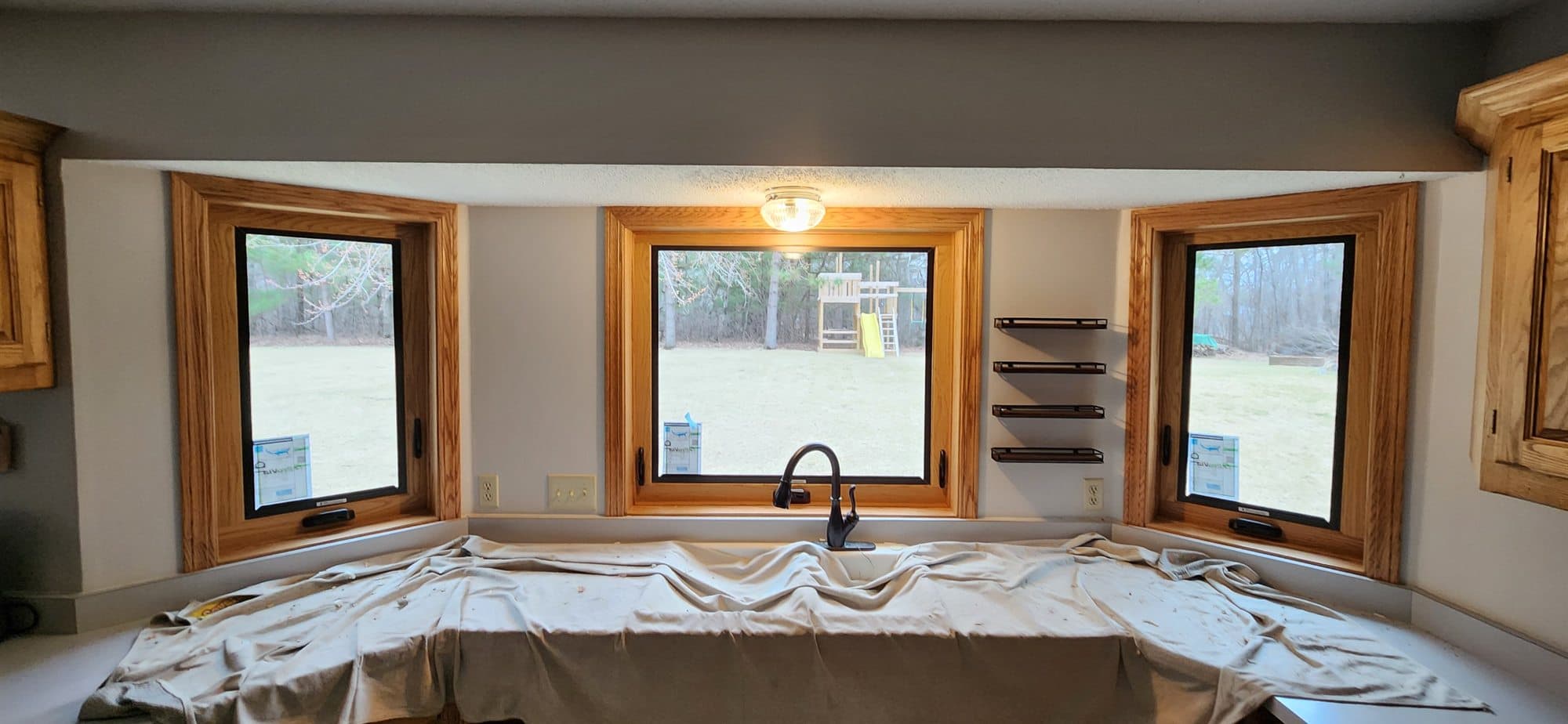
Painted trim hides a lot: finger-jointed pine, MDF, filled nail holes, caulk at every joint. Stained trim hides nothing. The jambs show, the stool shows, the miters show, and the wood has to be one species with the grain running the right way. So a paint-to-stain swap is not a casing swap. The jamb extensions, the stool, the apron and the casing all come off and go back in stain-grade stock, and the joints are cut tight because there is no caulk to save them.
The other thing stained trim will not do is blend. A painted window next to a stained one, or new oak next to old oak in a different color, stands out from across the room. That is why this job is usually done a room at a time: every window in the kitchen, or every window in the living room, so the eye sees one thing. Matching the stain is its own step. We take a sample of the existing woodwork, or a cabinet door, and match the species and the color before any trim goes on.
JMB Builders swaps painted window trim for stained wood across the Twin Cities metro. Red oak is the most common match in Twin Cities houses from the eighties and nineties; white oak, maple, hickory, alder and knotty pine each have their own look, and we tell you which reads right against what you have. The trim goes in sanded and ready for stain, or prefinished before install so the nail holes are the only thing to fill. Staining and finishing is quoted as a separate line, or do it yourself.
What you supply
- A photo of the windows to be swapped and a close-up of the wood you want matched: a cabinet door, a stained door casing, a piece of flooring
- Which rooms — the whole room reads better than one window
- Whether the jamb extensions and stool are also painted (they almost always are) so we plan the full swap
- Your stain and finish choice if we are finishing it; staining is quoted as a separate line, or do it yourself
What JMB supplies
- Stain-grade casing, jamb extensions, stool and apron in red or white oak, maple, hickory, alder or knotty pine
- Removal of the painted trim and repair of the drywall edge where the old casing pulled it
- Tight-cut miters and glued joints, since stained trim cannot be caulked to hide a gap
- Grain-matched stool with horns and a matching apron
- Stain samples on the actual species so the color is approved before installation
- Trim installed sanded and ready for stain, or prefinished before it goes up with color-matched nail-hole putty
- Photos of the finished room in your job folder
- Staining and finishing when you want it done, quoted as its own line
How it is priced: per window
Quoted in writing from your photos within one business day. What moves the number:
- Species — knotty pine and red oak at one end, hickory, cherry and white oak at the other
- Casing only vs. the full opening: jambs, stool, apron and casing, which is nearly always the real job
- Number of windows in the room, since the second and third are quicker than the first
- Matching an existing stain color vs. picking a new one
- Prefinished before install vs. installed raw for staining in place
- Casing profile — flat stock vs. a molded profile that has to be available in the species
- Drywall repair where old casing pulls the paper face
A close-up of the wood you want matched, in daylight, next to a white sheet of paper, gets the color reading right before we order stock.
How long it takes
One window: about two to three hours for the full swap, more if the trim is prefinished first. A room of four or five windows in a day. Staining in place adds a day or two of drying between coats.
How your project works
- 1
Send photos, get a written quote
Send three photos of the space and a sentence about what you want. You get a clear, itemized quote within one business day. We only come out to measure first when the job needs a tape measure — no pressure, no games.
- 2
Pick materials, or bring your own
We help you choose profiles and materials that fit the house and the budget, or match your existing millwork exactly — or you buy the door or trim yourself and we install it. Everything is confirmed before the crew is scheduled.
- 3
Clean, precise installation
The crew shows up on time, protects floors and furniture, and installs with tight joints and consistent reveals. Photos of the finished work go in your job folder.
- 4
Walkthrough and invoice
We walk the finished work with you. If anything is not right, we fix it before we call the job done. Then one invoice, paid by check or direct deposit — no card fees, no payment links.
Situations and options
Red oak to match eighties and nineties trim
The most common Twin Cities match. Red oak casing, jambs and stool with a stain matched to the existing doors and cabinets. Flat and molded profiles are both available in red oak, so the casing can match a profile already in the house.
Maple, hickory or alder
Maple for a light, even grain, hickory for the streaky look that matches hickory cabinets and floors, alder for a warm, softer wood that stains evenly. Available mostly in flat and simple profiles; we tell you what the species comes in.
Knotty pine for a cabin or farmhouse look
Wide flat pine casing with a thick stool, clear finished or lightly stained. Inexpensive, easy to match, and it suits pine walls and ceilings. Not a match for oak cabinets.
Prefinished before install
We stain and clear-coat the trim in the shop, then install it and fill the nail holes with color-matched putty. No taping off walls, no stain on the drywall, and the finish is even. The cleaner path in a finished house.
Replace Painted Trim With Stained Wood — Stain-Grade Window Casing: questions, answered
Can you replace painted window trim with stained wood without redoing the whole window?
Not really, and it is the first thing to understand. The jamb extensions and the stool are usually painted too, and they show as much as the casing once the trim is stained. Swapping only the face casing leaves painted jambs inside stained casing, which looks like exactly that. The full opening comes off and goes back in one species. It is more work than it sounds, and it is why we quote it per window.
How do you match new stained trim to my existing oak?
Species first, then color. Red oak and white oak look different under the same stain, so we confirm what you have from a close-up or a cabinet door. Then we stain samples of the actual trim stock and hold them against your woodwork in daylight until one reads right. Old oak has darkened with age, so the match is usually a shade warmer than the can says. The sample is approved before any trim is installed.
Should I do one window or the whole room?
The room. Stained trim does not blend the way painted trim does; one stained window in a room of painted ones, or one new-oak window next to old oak, stands out from the doorway. Doing every window in a room, and the door casing in that room if it is painted, makes it read as one decision. It is also cheaper per window than doing them one at a time over several visits.
What wood is best for stain-grade window trim?
The one that matches what is already in the house. Red oak is the usual answer in Twin Cities homes built in the eighties and nineties. Maple and hickory match kitchens with those cabinets. Alder stains evenly and suits a warmer, softer look. Knotty pine suits cabins and farmhouse rooms. If nothing has to be matched, we bring samples and you pick in your own light.
Do you stain the trim, or do I?
Either. We install the trim sanded and ready for stain and you finish it, or staining and clear-coating is quoted as its own line on the quote, in place or prefinished before install. Prefinished is cleaner in a lived-in house: no masking, no stain on the walls, and only the nail holes to putty afterward.
Will removing the painted casing damage the walls?
Some. Old casing is nailed and caulked to the drywall, and pulling it usually tears a strip of paper face along the edge and leaves a ridge of caulk. We cut the caulk line first, pull carefully, and repair what tears. Stain-grade casing is often slightly wider than the painted casing it replaces, which covers the repaired edge. Any paint touch-up on the wall is a separate line.
Get a written quote for this job
Three photos and a sentence is enough. You hear back within one business day. Or text the photos to 763-204-2099.
Related jobs we do
Match Old Window Trim Profile — Historic Casing Replacement
One window in a 1920s house got new trim that matches nothing, or the old casing is gone and the lumberyard has never seen the profile. We get the profile made and put it back.
Read moreCabin Window Trim — Cedar and Pine Casing for Log Walls
New windows in a log wall, or pine walls in a cabin with the windows still bare. We trim them in wood that fits the place and fasten it so the logs can keep moving.
Read moreBaseboard & Casing Installation
Straight lines, tight miters, and coped inside corners — baseboard and window & door casing installed room by room or across your whole home.
Read moreJamb Extensions for Windows — Installation & Casing
The window frame stops short of the wall and there is nothing to nail casing to. Extension jambs fix that — sized to your wall, set straight, reveal even, cased the same day.
Read moreTrim Painting and Interior Door Painting After Installation
New trim is only finished when it is painted. We do that part too: fill, caulk, prime, enamel, and the doors sprayed flat, sequenced with the carpentry so the room is done once.
Read moreArched Window Trim — Casing and Jambs for Round Top Windows
The window company set the arch and stopped. The straight legs are easy; the curve is where most trim jobs fall apart, and it is the part you look at every day.
Read morePage reviewed September 24, 2026 · JMB Builders LLC, MN license BC809005 · All window trim pages
Where we work
Window trim near you
Based in Zimmerman, scheduling across the Twin Cities metro. Closest first: