
Stain New Trim to Match Existing Woodwork — Oak, Pine and Maple
One new window in a house full of honey oak, a replacement door in a 1990s pine trim package, or an addition that has to look like it was always there: the new wood has to match the old.
JMB Builders stains new trim to match existing woodwork across the Twin Cities metro. We match the species first, then build sample boards on offcuts of the new trim with conditioner, stain and topcoat until one reads right against your old casing in daylight. The trim is stained and finished before it goes on the wall, so the joints stay clean. Priced per project, quoted from your photos within one business day.
- Species matched first, then the color
- Sample boards approved before the trim is stained
- Stained and topcoated before installation
- Quote from photos in 1 business day
- Licensed MN contractor BC809005
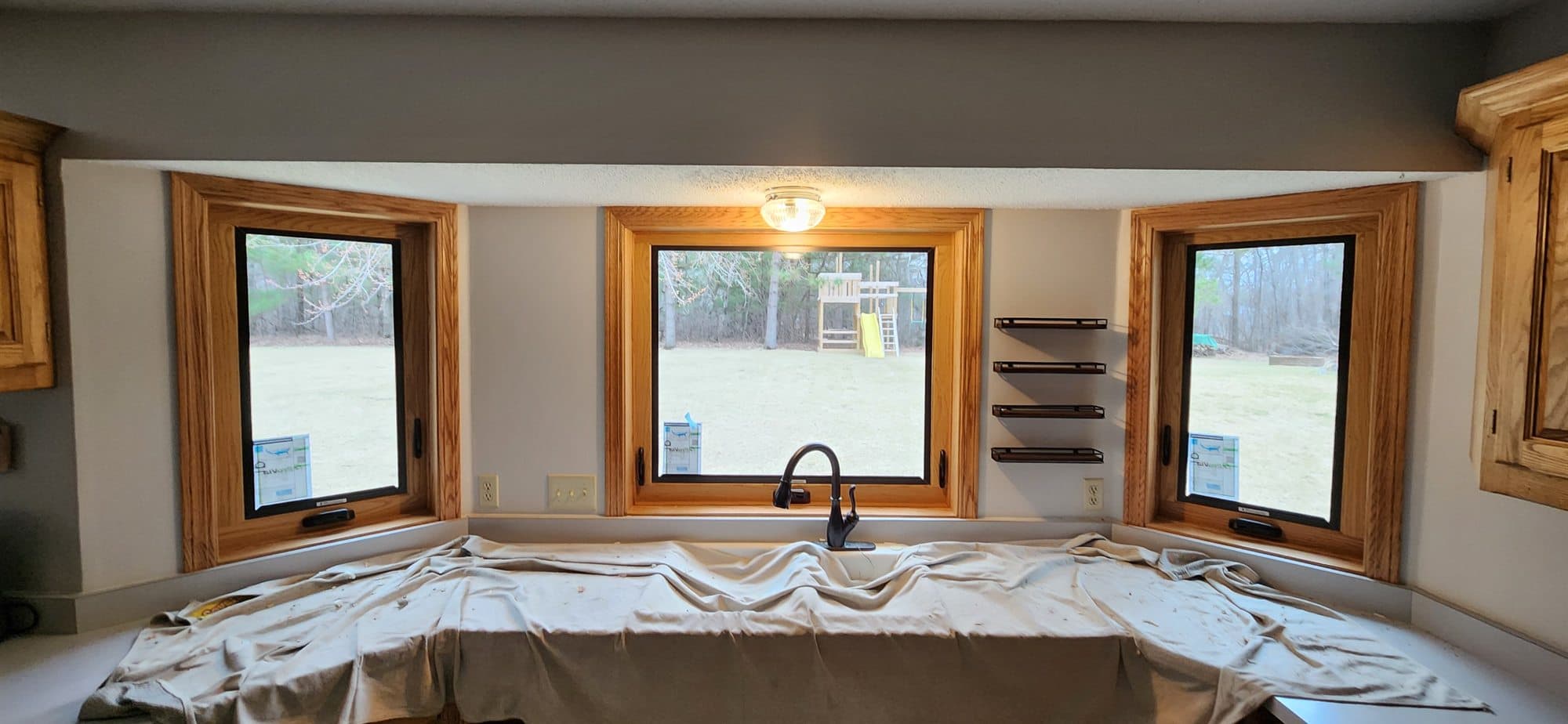
Painted trim forgives. Stained trim does not. When a new casing sits next to twenty-year-old oak, the eye finds the difference from across the room: the new one is pinker, or yellower, or the grain is wrong. The first mistake is buying the wrong species. Red oak next to white oak, or a poplar casing next to pine, will never match no matter what stain goes on it.
The second mistake is staining from the can. The color on the lid was tested on a different board under different light, and the old trim has darkened for years under a topcoat that has yellowed. Matching means mixing: a base stain, sometimes a second color to pull it warmer or cooler, a conditioner on pine and maple so it does not blotch, and the same sheen of topcoat the old trim has. That is done on sample boards, not on your casing.
We do the carpentry and the finish on the same job. New trim gets sanded, conditioned, stained and topcoated on sawhorses, then cut and installed, then the nail holes get filled with a color-matched putty. Staining after installation means stain on the wall and a thin coat at every joint.
What you supply
- A close-up photo of the old trim in daylight, and a piece of it if any is coming off
- The new trim if you already bought it, with a word about the species on the label
- Any leftover stain or finish from the original job, if you have a can in the basement
- Your yes on the sample board before we stain the run
What JMB supplies
- Species check on the old trim: red oak, white oak, pine, fir, maple, birch or cherry, before anything is ordered
- New trim in the matching species and profile, or a check that what you bought will take the color
- Three to four sample boards on offcuts of the new trim, each with conditioner, stain mix and topcoat
- Pre-stain conditioner on pine, maple, birch and cherry so the stain takes evenly
- Stain mixed to the sample, applied and wiped on sawhorses, then a topcoat in the sheen the old trim has
- Installation after the finish has cured, nail holes filled with a color-matched putty
- The mix written on the lid and the leftover left with you for the next piece
- Photos of the finished trim beside the old in your job folder
How it is priced: per project
Quoted in writing from your photos within one business day. What moves the number:
- How much trim: one window, one door, or a room's worth of casing and base
- Species: oak takes stain evenly, pine and maple need conditioner and more test boards
- How far the old trim has darkened, which sets how many stain mixes it takes to land the color
- Whether the old finish is lacquer, oil varnish or water-based, since the topcoat has to match its sheen and tone
- New trim we supply vs. trim you bought that may need extra sanding or a different species
- Stain-grade carpentry, which runs slower than paint-grade because every joint shows
- A door slab or a jamb stained to match on the same job
Send a close-up of the old trim next to a piece of white paper in daylight, and a photo of the whole room. If you have the old stain can or know the builder's finish, say so; it saves a sample round.
How long it takes
Sample boards: two to three days including your look at them. One window or door, stained, finished and installed: about a day after the sample is approved. A room of casing and base: two to three days.
How your project works
- 1
Identify the wood
From your photo or a piece of the old trim we name the species and the kind of finish on it. Then we source the new trim in that species and profile, or check the trim you already bought.
- 2
Sample boards
Offcuts of the new trim get sanded, conditioned, stained with two or three mixes and topcoated. You hold them against the old trim in daylight and pick one. If none is right, another round.
- 3
Finish on sawhorses
Every piece is sanded, conditioned, stained and wiped, then topcoated in the matching sheen, all before it is cut to length. Finishing first keeps stain off the walls and gives every joint a full coat.
- 4
Install and fill
The trim is cut, coped and nailed once the finish has cured. Nail holes get a color-matched putty, and any raw end grain at a cut gets a touch of the same stain. Photos go in your job folder.
Situations and options
Honey oak from the 1990s and 2000s
The most common match in the metro. Red oak with a golden stain under a varnish that has ambered. New red oak gets a mix that lands the amber, then a topcoat in the same satin or semi-gloss. White oak will not match it; we check before ordering.
Pine and fir trim in older houses
Pine blotches without a conditioner and darkens fast on its own. Old fir has gone orange-red under shellac or varnish. Sample boards matter most here, and the mix often takes two stains. Conditioner goes on every piece before color.
Maple, birch and cherry
Tight-grained woods that take stain unevenly and can go blotchy. Conditioner or a dye stain under a pigment stain, tested on the sample boards. Cherry keeps darkening on its own for years, so a fresh piece is matched a shade light.
Stain-grade trim in an addition
A whole room or wing of new casing, base and doors matched to the rest of the house. The sample is approved once, the mix is written down, and every piece is finished the same way on sawhorses before it goes on the wall.
Stain New Trim to Match Existing Woodwork — Oak, Pine and Maple: questions, answered
Can you match new trim to my existing stained trim?
Close enough that you have to look for it, if the species is right. We identify the wood on your old trim first, use the same species for the new pieces, and mix the stain on sample boards until one matches in daylight. A perfect match to wood that has darkened for twenty years is not always possible on day one; the new trim keeps aging toward the old, so we aim a touch light when the old finish is very amber.
Why does new oak trim look pink or yellow next to the old trim?
Because the old trim has changed color. Oil varnish and lacquer amber with age and sun, and the wood underneath darkens too, so a stain that matched twenty years ago reads too light and too pink now. New red oak also starts pinker than white oak. The fix is a stain mixed to the old color as it is today, not the color on the can from the original job.
Do you need wood conditioner before staining trim?
On pine, maple, birch and cherry, yes. Those woods soak up stain unevenly and go blotchy without a pre-stain conditioner that evens out how much the surface takes. Oak has an open, even grain and usually does not need it. Conditioner lightens the final color a little, which is why the sample boards get it too, so what you approve is what goes on the wall.
Do you stain the trim before or after installing it?
Before. Every piece is sanded, conditioned, stained and topcoated on sawhorses, then cut and installed once it has cured. Staining after installation puts stain on the wall paint, leaves the joints thin, and makes a wipe-on finish hard to control on a vertical surface. After install the nail holes get a color-matched putty and cut ends get a touch of the stain.
Can you match the stain if I already bought the trim?
If it is the same species as your old trim, yes, and we start with sample boards on offcuts of your pieces. If it is a different species, poplar or pine against oak for example, no stain will make the grain match and we will tell you before any of it goes up. Send a photo of the label or the end grain and a photo of the old trim and we will check it before you unwrap the bundle.
What topcoat goes over the stain?
The one that matches what is on the old trim in sheen and tone. Most older stained trim has an oil-based varnish or a lacquer, both of which amber; a water-based clear stays paler and would read cool next to them. We look at the old finish, pick the topcoat on the sample boards with the stain, and apply two coats with a light sand between. You approve the board, not just the stain.
Recent JMB work, from our job log
59 installs recorded across 30 Twin Cities communities since Dec 2025. Window and door installs for homeowners and for the builders and dealers we sub for. Counts come straight from our job log; no customer names.
Get a written quote for this job
Three photos and a sentence is enough. You hear back within one business day. Or text the photos to 763-204-2099.
Related jobs we do
Trim Painting and Interior Door Painting After Installation
New trim is only finished when it is painted. We do that part too: fill, caulk, prime, enamel, and the doors sprayed flat, sequenced with the carpentry so the room is done once.
Read moreBaseboard & Casing Installation
Straight lines, tight miters, and coped inside corners — baseboard and window & door casing installed room by room or across your whole home.
Read moreInterior Door Installation & Replacement
Doors that close with a solid click, swing true, and match throughout the house — bedroom, bathroom, and closet doors installed by a licensed contractor who hangs doors for a living.
Read moreWindow Trim & Casing for New Construction
Wood jambs and casing added to every window and patio door your builder wrapped in drywall — installed after closing, before or after you move in, by a licensed Minnesota contractor.
Read moreReplace Door Casing Only — New Trim on Existing Doors
The doors are fine. The skinny clamshell casing around them is not. New trim on every door in the house changes the whole place and does not need a single door replaced.
Read moreAccent Wall Painting — One Wall in a Dark or Bold Color, Sharp Lines
You want one wall in navy, charcoal, forest green or terracotta, and you want the line where it meets the white wall to be dead straight — that is the whole job, and it is a half day for us.
Read morePage reviewed September 26, 2026 · JMB Builders LLC, MN license BC809005 · All painting pages
Where we work
Painting near you
Based in Zimmerman, scheduling across the Twin Cities metro. Closest first: