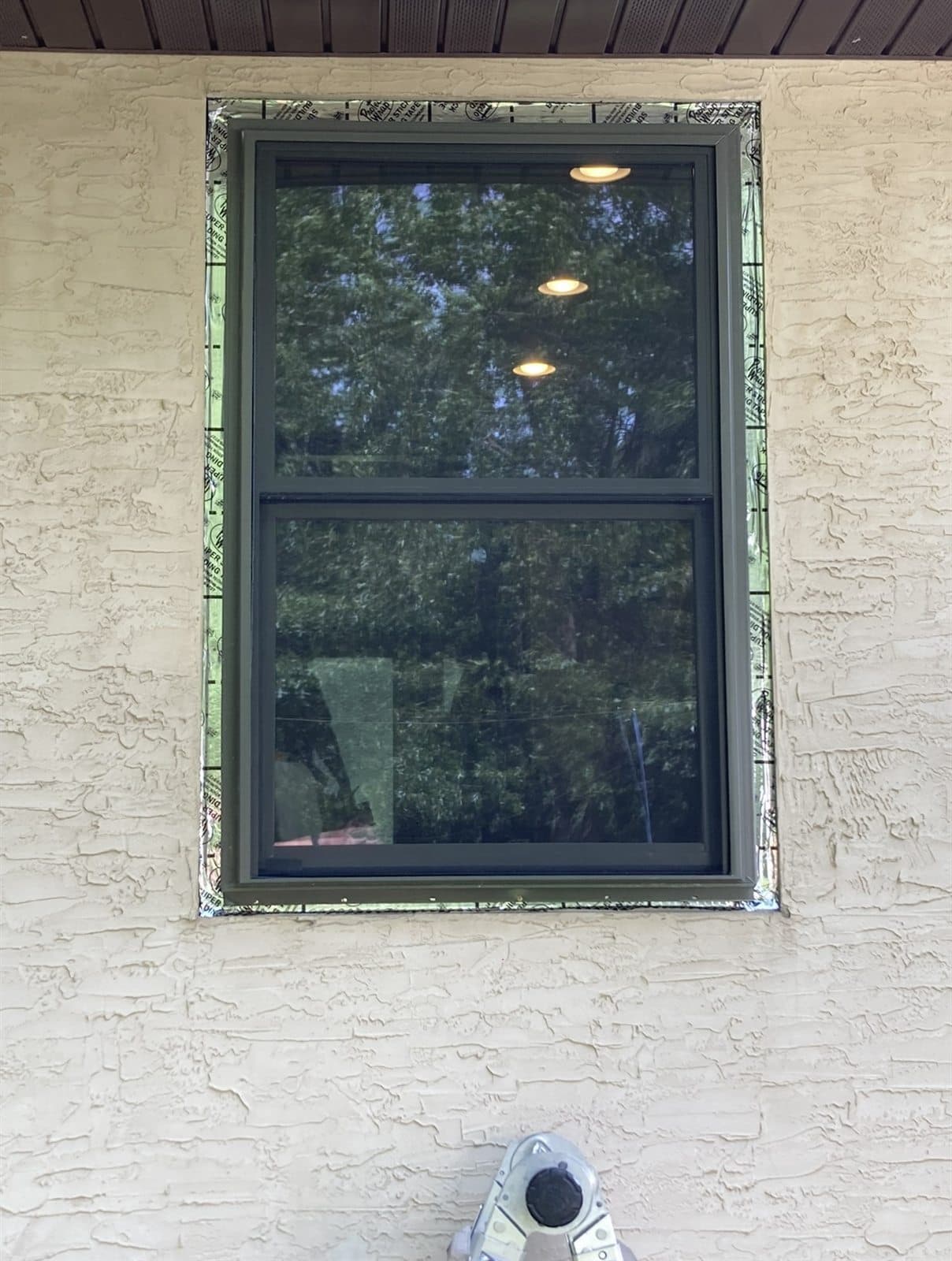
A window frame contributes a large share of the whole-unit U-factor, and on most products the frame insulates worse than the glass beside it. Hollow vinyl relies on trapped air in extruded chambers; foam fill and more chambers improve it. Fibrex is a wood-fiber and PVC composite; pultruded fiberglass is stiff and stable; wood insulates well on its own; bare aluminum conducts cold straight through the wall.
This is not a buying guide for vinyl vs fiberglass vs wood; we have one of those at jmbbuildersmn.com/blog/vinyl-vs-fiberglass-vs-wood-windows. This post covers one thing: what each frame material does to the insulation of the window, and how to read that from the label.
How much of a window's insulation comes from the frame?
Look at a typical double-hung from across the room. The frame, the sash rails and the meeting rail take up a surprising amount of the opening; on a small window they can be a third of the face. Every square inch of that is frame material, not glass, and it insulates differently.
Glass makers publish a center-of-glass U-factor, measured in the middle of the pane where only the glass, coatings and gas fill matter. A good double-pane Low-E argon unit has an excellent center-of-glass number. The NFRC label does not use that number. It reports a whole-window U-factor that averages the center of glass, the edge of glass where the spacer sits, and the frame. The frame and edge pull the average up, which is why the label number is always worse than the glass brochure number.
That is the whole point of caring about frame material. Two windows with the same glass package can land on different sides of the ENERGY STAR Northern line, currently a U-factor of 0.22 or lower on the prescriptive path, because of what the frame is made of and what is inside it.
Hollow, multi-chamber or foam-filled vinyl: what matters?
A vinyl frame is an extrusion: hot PVC pushed through a die into a hollow profile with internal walls. The hollows are what insulate. Still air is a decent insulator as long as it stays still, and a vinyl frame is really a series of small air pockets separated by thin plastic walls.
In a large hollow, the air does not stay still. Warm air on the room side rises, cools against the outside wall of the chamber, sinks, and circulates. That convection loop carries heat across the frame. Dividing the hollow into more, smaller chambers breaks the loop; filling it with foam stops it completely.
Foam-filled vinyl has polyurethane or polystyrene foam injected into the main chambers of the frame and sometimes the sash. It improves the frame's insulation and stiffens the profile so a wide frame does not bow in the sun. The improvement in whole-window U-factor is real but modest, because the frame is a fraction of the unit and the chambers were already doing some of the work. It shows up most on triple-pane windows, where the glass is so good that the frame becomes the limiting piece.
Not every chamber gets filled. Manufacturers leave the chambers that carry drainage or hold the balance hardware empty. Ask which ones are foamed, and whether the sash is foamed as well as the frame.
Multi-chamber extrusions are the other half of the story. Cut a cheap vinyl frame in half and you find two or three big hollows. Cut a good one and you find six or more, arranged so that no air pocket spans the whole depth of the frame. The more walls the heat has to cross, and the smaller each pocket, the less convection and the better the frame insulates.
The chambers also matter structurally. Thin vinyl walls in a well-designed multi-chamber profile add up to a frame that stays square when the sash is heavy and the sun is hot. A hollow builder-grade frame relies on wall thickness alone, and in a wide slider or a big picture unit that is where the frame bows and the seal opens.
Fusion-welded corners finish the job. The frame members are heated and pressed together so the chambers are sealed at the corners instead of screwed together with a gap. A screwed corner is a path for air and water into the frame; a welded corner is not.
- Two or three chambers, thin walls: entry-level vinyl. Adequate glass performance, mediocre frame.
- Five or more chambers, welded corners: mid-range and better vinyl. Most ENERGY STAR Northern windows are here.
- Multi-chamber plus foam fill in frame and sash: the top of the vinyl range, usually paired with triple-pane glass.
Fibrex and other composites: what are they made of?
Fibrex is Andersen's composite: 40 percent wood fiber by weight, mostly reclaimed from its own wood window production, bound in 60 percent thermoplastic polymer, which is PVC. It is extruded like vinyl into hollow profiles, so it insulates the same way, with chambers of trapped air, and some profiles are foam-filled.
What the wood fiber changes is stiffness and expansion. Fibrex is stiffer than plain vinyl, so profiles can be narrower for the same strength, which puts more glass and less frame in the opening. It also expands and contracts less than vinyl with temperature, which matters for keeping the glass seal and the weatherstripping in contact from a minus-twenty night to a July afternoon.
Other composites work on the same idea with different recipes: wood flour or cellulose in a polymer, or a fiberglass-reinforced polymer skin over a foam or wood core. Some are hollow extrusions, some are solid. Read them the same way you would read vinyl: how many chambers, is it foam-filled, are the corners welded, and what is the whole-window U-factor on the label.
Why is pultruded fiberglass a strong insulator?
Pultruded fiberglass is glass fiber pulled through a resin bath and a heated die, coming out as a stiff, straight hollow profile. It is the same glass as the window pane, in fiber form, in a plastic binder. That gives it a coefficient of thermal expansion in the range of about 5 to 10 millionths per degree Celsius, close to glass itself and far below aluminum at about 23. Vinyl is higher again.
The insulation of fiberglass frames comes from the same place as vinyl, trapped air in chambers, and most quality fiberglass frames are foam-filled because the profiles are thin and would otherwise have large hollows. Fiberglass itself conducts heat poorly, and the thin walls mean less material to conduct through.
The expansion match is the real advantage for insulation over time. When the frame and the glass move together, the sealant between them stays put, the weatherstripping stays in contact, and the frame does not creep away from the foam around it. A frame that grows and shrinks more than the glass every day works the seal at its edge; fiberglass does that far less.
Wood and clad wood: still a good insulator?
Solid wood is a naturally decent insulator, better than the same thickness of vinyl wall or any metal, because it is full of tiny air cells. A traditional wood frame does not need chambers or foam; the material itself does the work. That is why old wood windows with a good storm panel can feel warmer at the frame than a hollow vinyl replacement.
The catch is moisture. Wood that gets wet and stays wet swells, loses insulating value and eventually rots. Clad wood puts an aluminum, vinyl or fiberglass skin on the exterior faces to keep weather off the wood while leaving the interior as paintable or stainable wood. The insulation comes from the wood core; the cladding is there for durability.
Aluminum cladding does not turn the frame into a cold bridge because it is a thin skin on the outside face only, not a member that runs through from outside to inside. The wood behind it stays the insulator. Where clad wood fails is at the joints and the sill, when water gets behind the cladding and cannot get out, so the sill nosing and the drainage details matter as much as the material.
Why do aluminum frames sweat and frost?
Aluminum conducts heat hundreds of times faster than wood, vinyl or fiberglass. A frame made of a solid aluminum extrusion is a straight metal path from the outside air to the inside room. On a January night the interior face of the frame is nearly as cold as the outside, room air touching it drops below its dew point, and water beads and then freezes on the metal. That is thermal bridging, and it is why bare aluminum windows are a bad fit for a Minnesota house.
A thermal break fixes the worst of it. The frame is made as two aluminum pieces, inside and outside, joined by a strip of low-conductivity plastic or poured polyurethane so the metal is not continuous. Commercial storefront and better aluminum residential windows have this. It helps a lot, but the frame still insulates worse than any of the other materials in this post.
In a house, aluminum shows up on 1960s and 1970s sliders and on older patio doors, usually single-pane or early double-pane with no Low-E. If you have them, the frost line on the frame is your answer. Replacing them is one of the few window jobs that pays back in comfort on the first cold night.
Frame U-factor vs center-of-glass: which number is on the label?
Only the whole-window U-factor is on the NFRC label. The frame does not get its own line, but its effect is baked into the number. The table gives the practical picture for the same Low-E argon double-pane glass in different frames. No numbers, because the whole-window result depends on the exact profile and size; the ranking is what holds.
| Frame | How it insulates | Effect on whole-window U-factor | Watch for |
|---|---|---|---|
| Aluminum, no thermal break | Solid metal conducts straight through | Worst by a wide margin; frosts inside | Interior condensation, rusted screws, soft stool |
| Aluminum, thermal break | Plastic strip interrupts the metal | Still the weakest frame in this list | Break strip condition, corner joints |
| Hollow vinyl | Trapped air in a few chambers | Middle of the pack | Bowing in wide units, screwed corners |
| Multi-chamber or foam-filled vinyl | Many small pockets or solid foam | Better; often the difference for ENERGY STAR Northern | Which chambers are foamed, sash vs frame |
| Fibrex and similar composites | Chambers, sometimes foam, in a stiffer extrusion | Similar to good vinyl with narrower profiles | Same checks as vinyl |
| Pultruded fiberglass, foam-filled | Low-conductivity walls plus foam | Among the best; stable at the seals | Sealant at corners, paint finish |
| Wood and clad wood | Solid wood cells insulate | Among the best when dry | Sill drainage, joints behind cladding |
What JMB Builders does
JMB Builders is a licensed Minnesota residential building contractor (BC809005) based in Zimmerman, working across the Twin Cities metro. We install vinyl, composite, fiberglass and wood windows from any brand, whether we order them or you bring them home. Every frame gets low-expansion foam in the gap, flashing outside and an air seal inside, because the best frame in the catalog is only as good as what is around it. Call 763-204-2099 or send photos through the site.
- Labor-only installation of windows you bought at a store or online — jmbbuildersmn.com/services/labor-only
- Install a window you ordered online, labor only — jmbbuildersmn.com/services/doors/install-window-bought-online
- Insert and full-frame replacement windows, measured and ordered by us — jmbbuildersmn.com/services/full-service
- Interior trim-out after the window is in: jamb extensions, stool and apron, casing — jmbbuildersmn.com/services/window-trim
- Send three photos per window, written quote within one business day.
Frequently asked questions
Does a foam-filled vinyl window frame make a difference?
Yes, a modest one. Foam stops air from circulating inside the frame chambers, which lowers the frame's share of heat loss and stiffens the profile. On a double-pane window the whole-window U-factor improves a little; on a triple-pane window, where the glass is already very good, the frame is the limiting piece and the foam matters more.
What is Fibrex made of?
Fibrex is Andersen's composite of 40 percent wood fiber and 60 percent thermoplastic PVC polymer by weight, combined under heat and pressure and extruded into hollow profiles. It insulates like vinyl, with chambers of trapped air, but is stiffer and expands less with temperature, so profiles can be narrower and the seals stay in contact through temperature swings.
Is fiberglass a better insulator than vinyl for window frames?
As a material, fiberglass and vinyl both conduct heat poorly, and both frames insulate mainly through trapped air and foam fill. The advantage of pultruded fiberglass is stability: it expands and contracts at close to the rate of glass, so the glass seal and weatherstripping stay tight over years of Minnesota temperature swings. Whole-window U-factors for good fiberglass and good foam-filled vinyl are often close.
Why do my aluminum window frames frost on the inside?
Aluminum conducts heat straight through the frame, so the interior face of the metal gets nearly as cold as the outdoors. Room air touching it falls below its dew point, condenses and freezes. A thermal break, a plastic strip separating the inside and outside metal, reduces this, but bare aluminum frames from the 1960s and 1970s have none and will frost every winter regardless of the glass.
Is the U-factor on the label for the glass or the whole window?
The NFRC label reports the whole-window U-factor, which averages the center of glass, the edge of glass at the spacer and the frame. Glass brochures often quote a center-of-glass number that is much better, because it leaves out the frame. Only the whole-window number counts for ENERGY STAR, which requires 0.22 or lower for a Northern-zone window on the prescriptive path.
Do wood windows insulate as well as vinyl?
Solid wood insulates well on its own because the wood cells are full of tiny air pockets, and a dry wood frame is comparable to or better than a hollow vinyl frame. Clad wood keeps that insulating core and adds an aluminum, vinyl or fiberglass skin outside for weather protection. The weak point is water: a wood frame that stays wet at the sill loses insulation and eventually rots.