
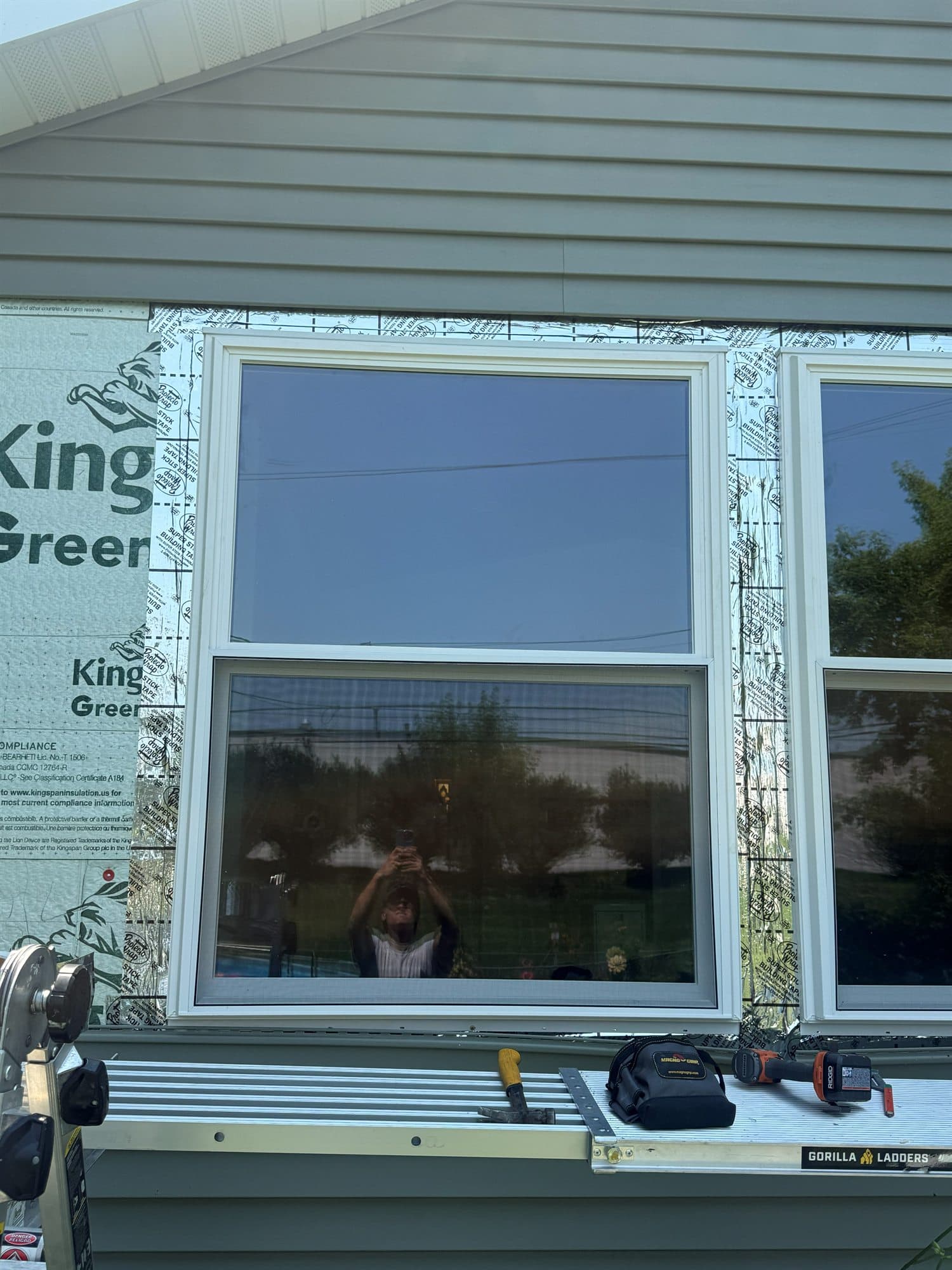
The difference between a new construction window and a replacement window is the fin. A new construction unit fastens through a nailing fin to the sheathing and becomes part of the wall's water management. A replacement unit has no fin, sets inside the old frame or a prepared opening, and is fastened through the jambs and sealed at the perimeter. The glass and frame material can be identical.
This applies to anyone buying a window for a Minnesota house: a builder framing an addition, a homeowner picking a unit off a store shelf, or a GC deciding what to spec on a re-side.
What is a new construction window?
A new construction unit carries a nailing fin, also called a flange, around the outside of the frame. The fin fastens flat to the wall sheathing and is taped into the weather-resistive barrier and flashing, so the window becomes part of the wall's drainage plane. It is the standard for new builds and additions, where the framing is open and the exterior is unfinished.
In an existing house, a finned window means exposing the sheathing: siding, brickmould or stucco comes off around the opening. That is why it is not the default for a simple replacement.
What is a replacement window?
A replacement unit, also called an insert, pocket or block frame window, has no fin. It is sized to fit inside the existing window frame or a prepared opening. It goes in from inside or outside without disturbing the siding or the plaster, fastened through the frame and sealed at the perimeter. It is the least invasive path and the standard for an occupied house with sound frames.
The trade-off is glass area. An insert sits inside the old frame, so the new frame plus the old frame takes up more of the opening than a full-frame replacement would. On a small window that loss shows.
Which one does your project need?
The rule decides most cases:
- New build or addition: new construction, finned, taped into the WRB.
- Sound existing frames, siding staying put: replacement insert. Fastest, cleanest, least labor.
- Rotted frames or a full-frame tear-out: finned unit if the exterior is being opened, or a finless unit with exterior trim details if not. This is the installer's call to explain.
- Re-siding project underway: finned new construction. With the siding off you can reset the flashing properly.
- Changing the opening size: new construction, since the framing is rebuilt anyway.
| New construction (nailing fin) | Replacement (insert / block frame) | |
|---|---|---|
| Fastened | Through the fin to the sheathing | Through the jambs to the old frame or framing |
| Water management | Fin taped into the WRB and flashing; part of the drainage plane | Exterior sealant and a sill pan or dam inside the old frame; relies on the old frame's flashing |
| Exterior disturbed | Yes: siding, brickmould or stucco off around the opening | No |
| Glass area | Full opening | Reduced by the old frame |
| Rot in the old frame | Removed and rebuilt | Sealed in the wall |
| Perimeter insulation | Low-expansion foam in the gap, interior air seal | Low-expansion foam in the gap, interior air seal |
How is each type flashed and sealed?
A finned window is flashed in shingle order. The sill gets a pan first: preformed or a flexible flashing membrane turned up at the back and ends so any water that reaches it drains out over the housewrap, not into the framing. The unit is set on the pan and shimmed. Jamb flashing goes over the side fins and laps onto the sill pan. Head flashing goes over the top fin and laps over the jambs. Then the housewrap flap above the window is folded down over the head flashing and taped. The bottom fin is left unsealed, or sealed with gaps, so the pan can drain. Every layer sheds onto the one below it.
An insert cannot be tied into the housewrap because the housewrap is behind siding that stays. It relies on the old frame's flashing, which is why the old frame has to be sound. The installer builds a pan or a back dam of sealant on the old sill, sets and shims the unit, and seals the exterior joint between the new frame and the old frame with a sealant that stays flexible, leaving weep paths at the bottom. The inside is where the air seal happens, on both types.
How is the gap around the frame insulated?
Both types leave a gap between the window frame and the rough opening or old frame. That gap is the single biggest air leak in a window install, and how it is filled matters more than which window type you bought.
The right fill is low-expansion window-and-door foam, applied in the gap so it expands to fill the depth without pushing on the jambs, then trimmed flush. Stuffed fiberglass, still common on older installs and on rushed ones, is not an air barrier. Indoor air moves through it to the cold framing, the moisture in that air condenses in the fiberglass, and wet fiberglass insulates poorly and can feed rot in the sill. High-expansion foam is the opposite failure: it bows the jambs inward and the sash stops sliding.
Foam alone is not the finish. At the interior edge, a backer rod pressed into the gap with a bead of sealant over it, or a continuous low-expansion foam bead, closes the warm side so indoor air cannot reach the frame. This is the interior air seal, and it goes on before the jamb extensions and casing. The trim covers it; the trim is not it.
Does the window type change the glass package?
No. The same manufacturer line is usually offered in both configurations with the same glass. What you are choosing on the glass is separate: Low-E coatings on the inner surfaces of the panes (on the inner pane it keeps more winter solar gain, on the outer pane it cuts gain on a hot west wall), argon fill as the standard or krypton in thin gaps, double or triple pane, and a warm-edge spacer that keeps the glass edge warmer and holds the gas seal. On the frame, look for multi-chamber or foam-filled profiles and compression weatherstripping.
Compare on the NFRC label: whole-unit U-factor and SHGC, and the air leakage rating where it is listed. Lower is better on U-factor and air leakage. All of Minnesota is in the ENERGY STAR Northern zone, and the Version 7.0 Northern criteria are the strictest U-factor tier in the program, so the Northern mark is a quick screen. The state energy code sets a maximum U-factor for new windows too; a Northern-zone ENERGY STAR unit is well inside it.
Then remember that every one of those numbers was measured with a sealed perimeter. Finned or insert, a window in a gap of stuffed fiberglass with no interior seal leaks air around the frame all winter, and that leakage outweighs what the glass saves. The homeowner feels a draft and blames the glass. The install cancelled it.
What goes wrong with the wrong one?
A finned window forced into a replacement job tears up exterior finishes for no reason. An insert set over a rotted frame seals the decay in the wall and gives up the chance to fix the flashing. Water problems from a mismatched window type and install method show up years later as stained drywall and soft sills.
Before you order, send a photo of the opening inside and out. Which type fits is usually clear from that.
What JMB Builders does
JMB Builders is a licensed Minnesota residential building contractor (BC809005) based in Zimmerman, working across the Twin Cities metro for homeowners, builders and GCs. We install both types, any brand, say which one an opening needs before it is ordered, and trim it out after. One crew, paid by check or direct deposit. Call 763-204-2099 (text) or send the plans or a photo of the openings, per-opening pricing, reply within one business day.
- Labor-only installation of finned or insert windows you bought — jmbbuildersmn.com/services/labor-only
- New construction window installation crew for builders — jmbbuildersmn.com/services/builders/window-installation-crew-new-construction
- Siding replacement with new windows, flashed with the siding off — jmbbuildersmn.com/services/siding/siding-replacement-with-new-windows
- Install a window you bought online — jmbbuildersmn.com/services/doors/install-window-bought-online
Frequently asked questions
Can you use a new construction window to replace an existing window?
Yes, if the exterior around the opening is opened up. The siding, brickmould or stucco comes off so the fin can fasten to the sheathing and tape into the housewrap. It is the right call on a re-side, a rotted frame or a size change. On a sound frame with siding staying, an insert does the job with far less work.
Can a replacement window be used in new construction?
It can be set in a new rough opening with exterior trim details, but it is the wrong tool. With the sheathing exposed, a finned unit ties straight into the flashing and the housewrap, which is the whole point of new construction. Order the finned unit for a new build or an addition.
How do I know if I need a nailing fin window?
Ask whether the sheathing will be exposed. New build, addition, re-side, size change or a rotted frame that is coming out to the studs: yes, nailing fin. Sound existing frame with the siding staying: no, order the insert. A photo of the opening inside and out settles it.
Can the nailing fin be cut off to make a replacement window?
Check the manufacturer's instructions first. Some lines are made for fin removal and say how to fasten the unit afterward. Cutting the fin off a unit that is not made for it changes how the window is fastened and sealed and can affect the product warranty.
Should the gap around a new window be foamed or stuffed with fiberglass?
Foamed, with low-expansion window-and-door foam, on both window types. Fiberglass is not an air barrier: indoor air passes through it, condenses on the cold framing, and leaves the fiberglass wet and useless. Then the interior edge gets backer rod and sealant or a continuous bead before the trim goes on, so the warm side is airtight.
Is the glass different on a new construction window and a replacement window?
Usually not. Most lines offer the same glass package in both: Low-E coating, argon fill, double or triple pane, warm-edge spacer. Compare the NFRC U-factor and SHGC and look for the ENERGY STAR Northern mark, which applies to all of Minnesota. The type changes how the window is fastened and flashed, not how the glass insulates.