
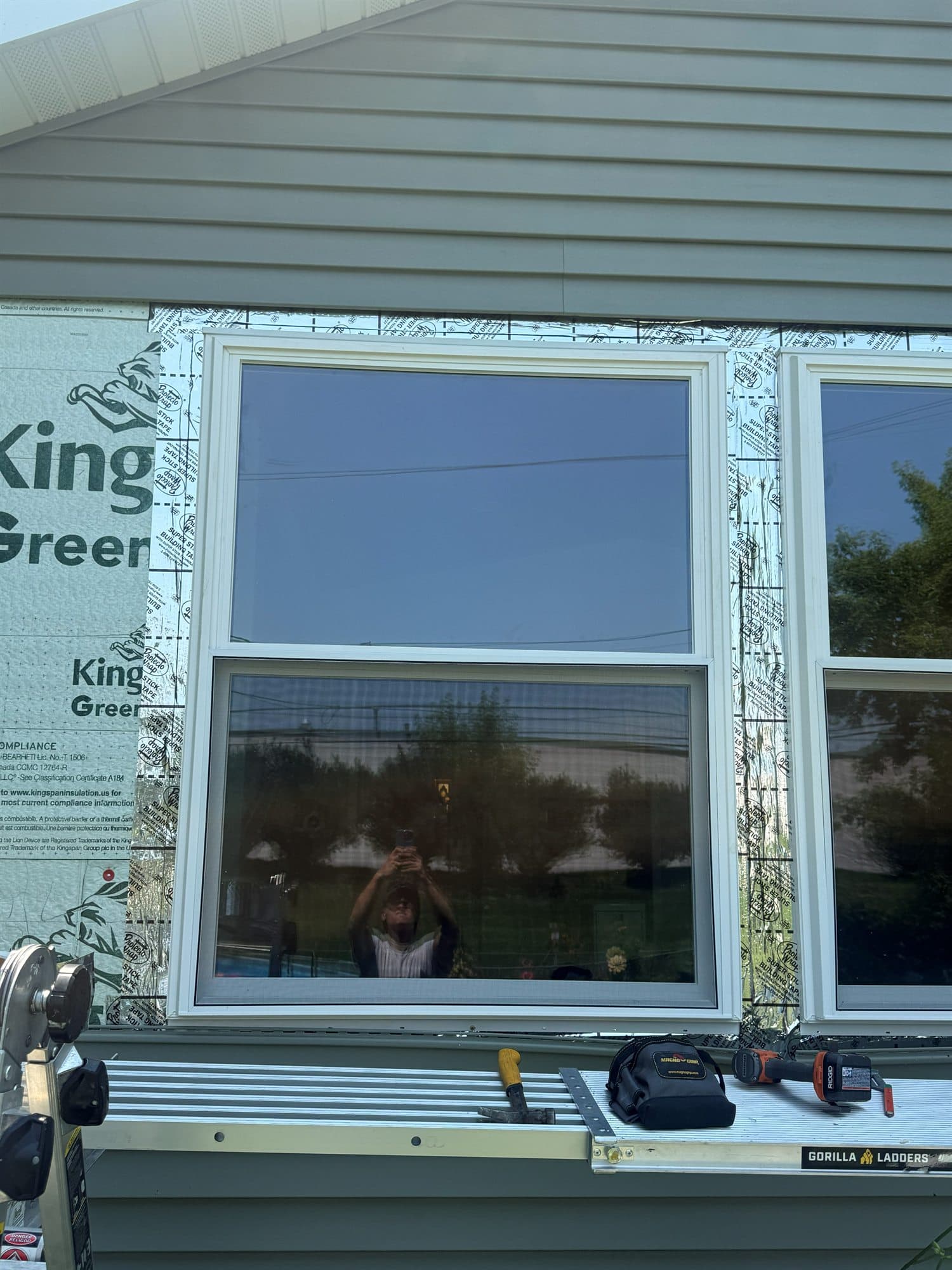
A jamb extension is the strip of wood or matching material that carries a window frame's interior edge out flush with the drywall so the casing has something to land on. Casing, stool and apron finish it. Together they are the part of the window you look at every day, and they are the part of a window quote most often left out or left vague.
This applies to any Minnesota homeowner comparing window quotes, and to builders deciding whether extensions come factory-applied or get built on site.
What is a jamb extension and why do you need one?
A window frame has a fixed depth. Walls do not. A 2x4 wall with drywall is about 4½ inches deep, a 2x6 wall about 6½, and sheathing, siding or thick plaster change it again. The jamb extension is the wood or matching material that carries the frame's interior edge out flush to the wall so the casing has something to land on. Without it there is a recessed gap between window and trim.
New windows in 2x6 construction almost always need extensions. Inserts into existing frames often inherit the old ones. Factory-applied or site-built, stained or painted, is the line item a good quote spells out.
What are the stool, apron and casing?
The stool is the interior sill shelf at the bottom of the window. The apron is the trim piece under it. The casing is the frame of trim around the sides and head. Together they set the window's interior style, from ranch-minimal to craftsman with a thick head casing.
In older Minneapolis and St. Paul homes, matching the existing stained casing profile is skilled work. One mismatched window in a room of original woodwork announces itself forever.
What is a drywall return?
A drywall return skips the casing and wraps the drywall into the window opening for a clean, minimal reveal. It needs precise work: corner bead, a square opening, and careful sealing at the window edge. It is a decision to make before ordering, because it changes the jamb depth you order to.
What is behind the trim, and why does it matter more than the trim?
Between the window frame and the framing there is a gap, usually a finger's width all the way around. What is in that gap decides whether the window is drafty, not the casing. Pull the casing on a cold January day and you find out fast which kind of install you have: frost on the jamb means air is getting through.
The right fill is low-expansion window-and-door foam, applied to fill the depth of the gap without bowing the jambs, and trimmed flush once it cures. Stuffed fiberglass is what a lot of older installs have, and it is not an air barrier. Indoor air moves through it to the cold sheathing, the moisture in that air condenses in the fiberglass, and wet fiberglass insulates poorly and can feed rot at the sill. High-expansion foam is the other failure: it pushes the jambs inward and the sash stops sliding.
Then the interior edge gets sealed. A backer rod pressed into the gap with a bead of sealant over it, or a continuous foam bead, closes the warm side so indoor air never reaches the cold frame. That is the interior air seal, and it goes on before the jamb extensions. On a window where the extensions are site-built, the joint between the extension and the window frame gets a bead too. The casing then covers a sealed opening. Caulking the casing to the drywall is a paint line, not an air seal.
This is also why a good glass package can feel like a bad one. Low-E coatings, argon fill, a warm-edge spacer and a low NFRC U-factor are measured on a unit with a sealed perimeter. Leave the perimeter open behind the trim and the air leaking around the frame outweighs what the glass saves. The homeowner blames the window. The trim carpenter had the fix in a caulk gun.
Should the jamb extensions be factory-applied or site-built?
Both work. Which one fits depends on how much you trust the wall depth.
| Factory-applied | Site-built | |
|---|---|---|
| Fit | Made to the depth you ordered; every opening must match it | Scribed to each wall as it is; forgives variation |
| Finish | Matches the window's interior finish out of the box | Paint-grade or stain-grade to match the room |
| Best for | New construction with consistent framing and a known wall depth | Older houses, remodels, plaster walls, anywhere depths vary |
| Air seal | Still needs foam in the gap and a bead at the interior edge | Same, plus a bead where the extension meets the frame |
| Where the labor goes | In the window price | In the trim line, per opening |
Why is the trim quoted separately?
Trim is the visible signature of the job: tight miters, even reveals, filled nail holes, clean caulk lines, stain that matches the room. It is also the step that covers the air seal, so it is the last chance to get the seal right.
It is its own work, so it is its own line. When you review a window quote, confirm what is in it: foam and interior seal, jamb extensions, stool and apron or picture-frame casing, the material and finish, and who paints. New trim goes in primed, filled and caulked. Painting is quoted as a separate line, or leave it primed and caulked and paint it yourself.
What JMB Builders does
JMB Builders is a licensed Minnesota residential building contractor (BC809005) based in Zimmerman, working across the Twin Cities metro. We do the interior trim-out after window install for homeowners, builders and window companies: foam and interior seal where it was skipped, jamb extensions, casing, stool and apron, or drywall returns, priced per opening. One crew, paid by check or direct deposit. Call 763-204-2099 (text) or send a photo of the openings, per-opening pricing, reply within one business day.
- Jamb extensions for windows, paint-grade or stain-grade — jmbbuildersmn.com/services/window-trim/jamb-extensions-for-windows
- Trim-out of replacement windows left bare by another company — jmbbuildersmn.com/services/window-trim/trim-out-replacement-windows-left-bare
- Window stool and apron — jmbbuildersmn.com/services/window-trim/window-stool-and-apron
- Interior trim-out partner for window companies — jmbbuildersmn.com/services/builders/window-company-trim-out-partner
Frequently asked questions
Do replacement windows need jamb extensions?
Often not. An insert sets inside the old frame, so the old jambs and casing usually stay and the new unit is trimmed to them. A full-frame replacement strips the opening, so it needs new extensions and casing like a new window. Check the quote for which one you are getting.
Should jamb extensions be factory-applied or site-built?
Factory-applied saves site labor and matches the window finish, but only when the wall depth is known exactly and is the same at every opening. Site-built extensions are scribed to the wall as it is, which is the safer choice in an older house or where walls vary. Either way the quote should say which.
What should be behind the window casing?
Low-expansion foam filling the gap between the window frame and the framing, and a backer rod with sealant or a continuous foam bead at the interior edge. That is the air seal that keeps indoor air off the cold frame. Stuffed fiberglass or an empty gap behind the casing is why a new window feels drafty.
Can new window trim match old stained casing?
Yes. The existing profile is measured and matched with a stock moulding or a custom-run piece, then stained to the room. It takes more time than paint-grade trim and is priced per opening. Send a photo of an existing window with a tape measure across the casing.
What is the difference between a stool and a sill?
The sill is the sloped exterior piece at the bottom of the window that sheds water outside. The stool is the flat interior shelf you set a plant on. The apron is the trim piece under the stool. People say sill for both, and quotes sometimes do too, so ask which one is meant.
Who paints the trim after the window is installed?
New trim goes in primed, filled and caulked. Painting or staining is quoted as a separate line on every job, or leave it primed and caulked and paint it yourself. Stain-grade trim is usually finished before or right after install so the color matches the room.