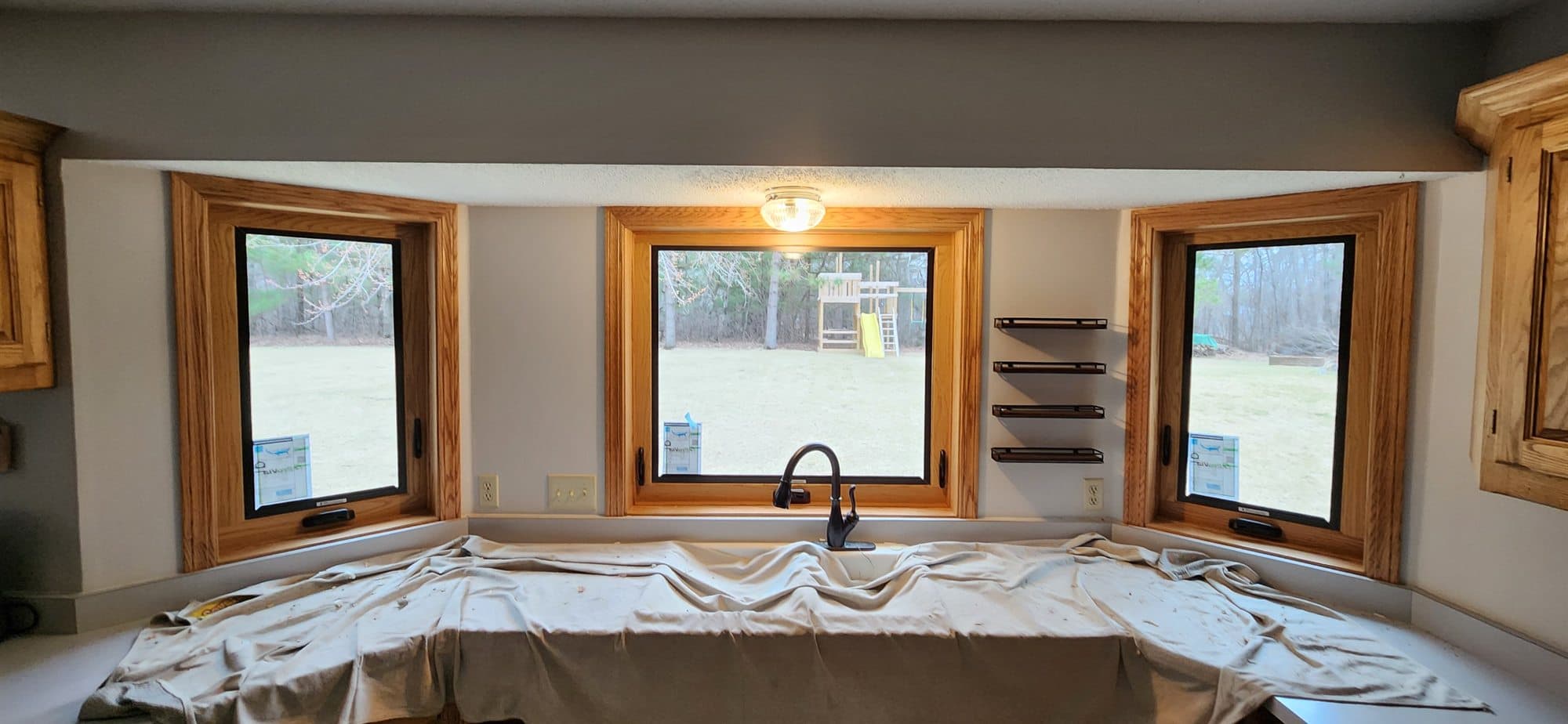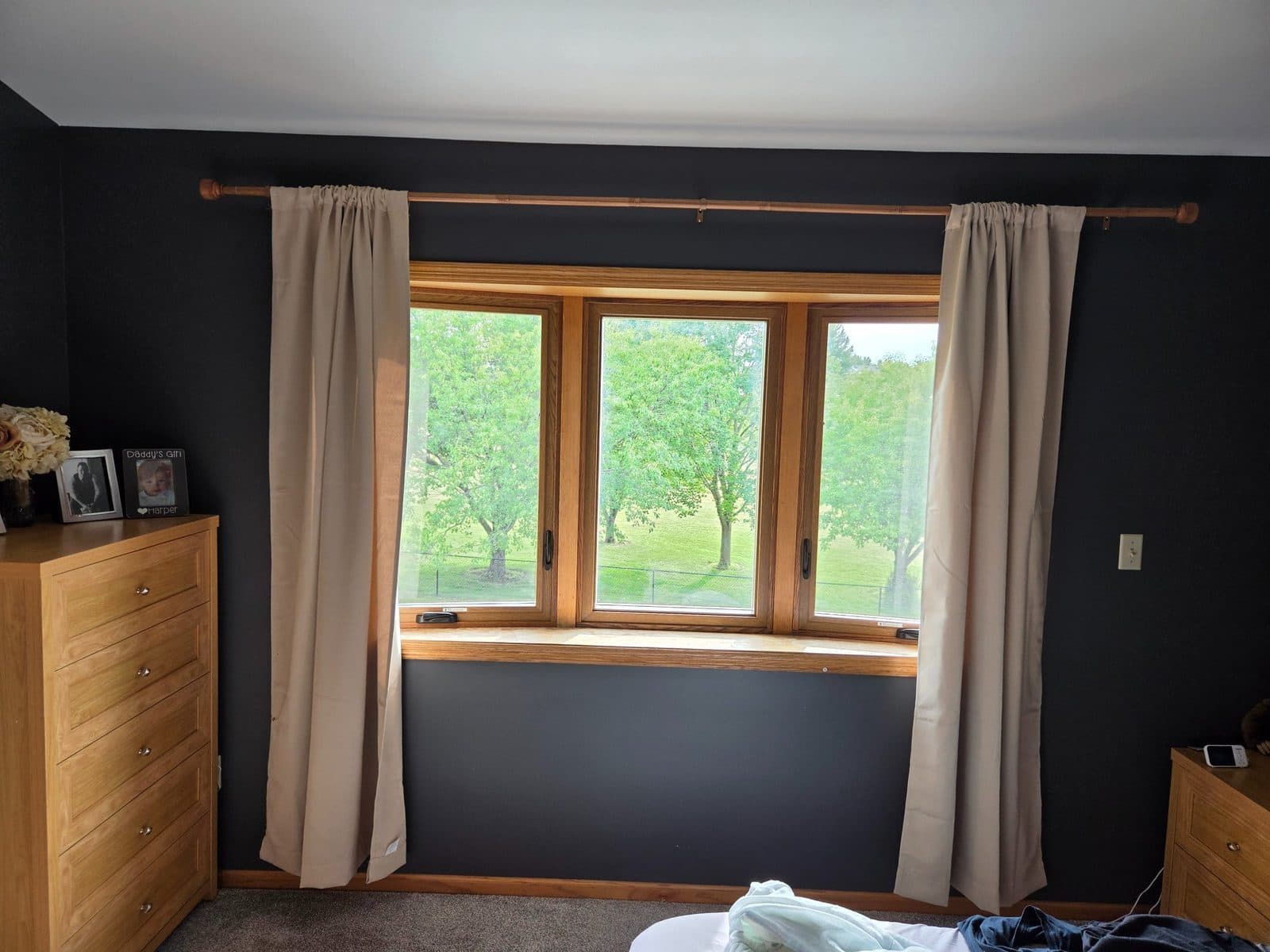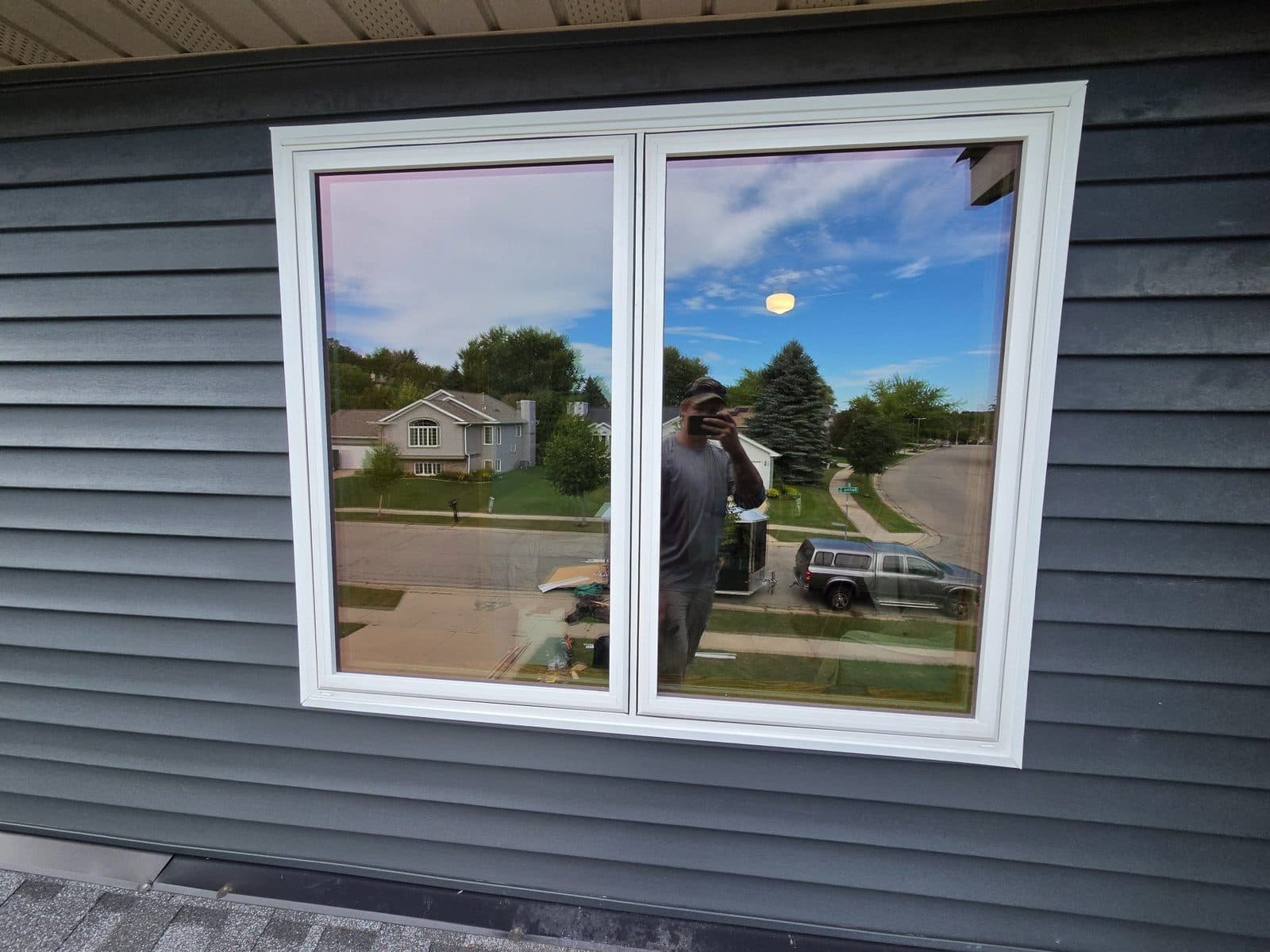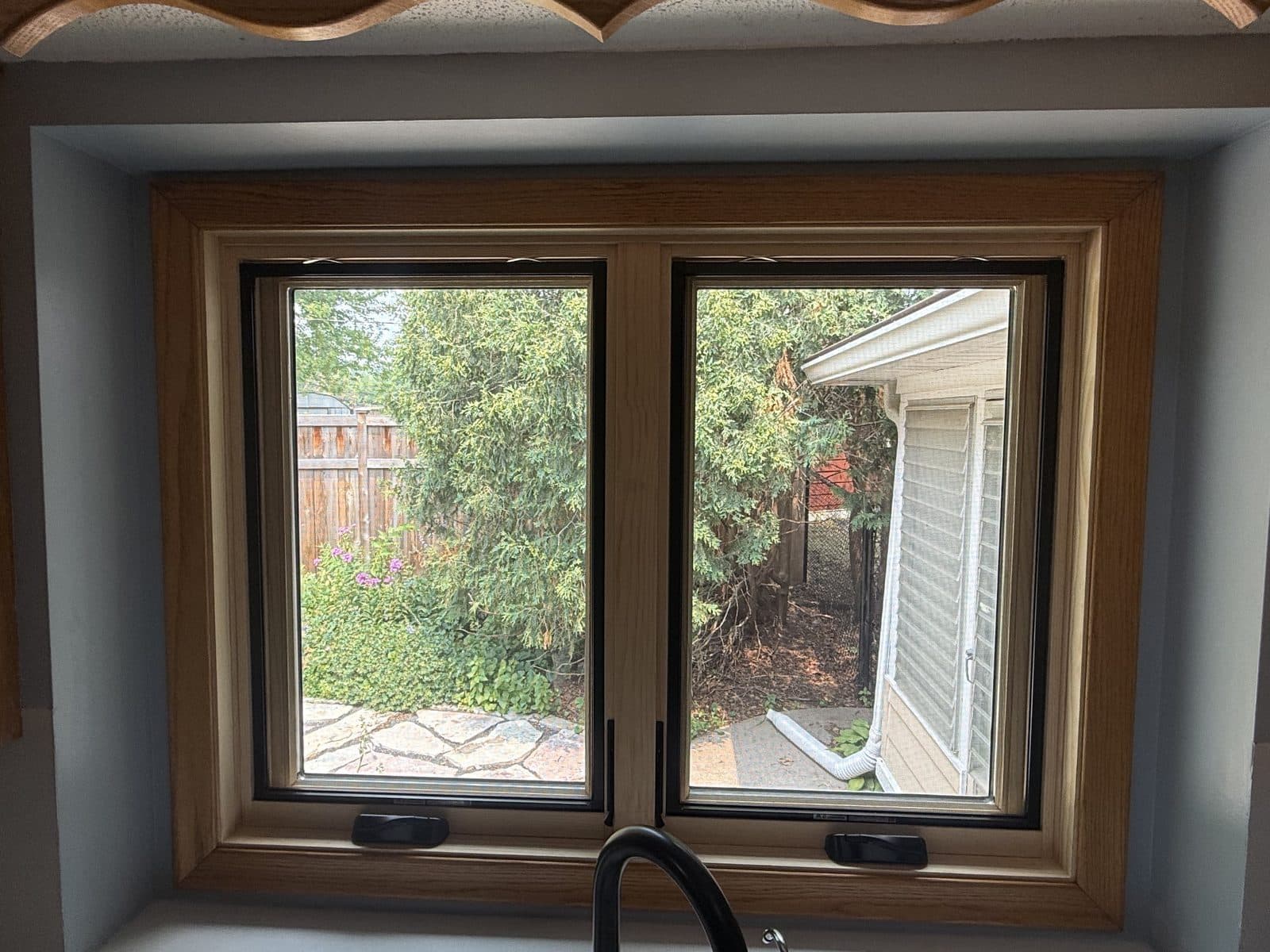
For a Minnesota house, buy a window with the lowest U-factor you can justify. The ENERGY STAR Version 7.0 Northern zone mark means a whole-window U-factor of 0.22 or lower (or 0.23–0.26 paired with a solar heat gain coefficient of 0.35 or higher), and a good double-pane low-E argon window lands around 0.26–0.30. SHGC, visible transmittance, air leakage and condensation rating are the fine-tuning by wall.
This applies to any Twin Cities homeowner comparing quotes or ordering windows to install labor-only. Every certified window ships with a National Fenestration Rating Council label on the glass, like the one on the picture window in the photo above. It is standardized and independently tested, which makes it the one honest way to compare brands.
What is U-factor, and what should it be in Minnesota?
U-factor measures how fast heat escapes through the whole window: glass, spacer and frame together, in Btu per hour per square foot per degree of temperature difference. Residential windows run from roughly 0.15 (the best triple-pane) to above 1.0 (single-pane), and lower is better. It is the inverse of R-value, so a U-0.25 window is about R-4, and a U-0.50 window is R-2.
In a climate with a long heating season, U-factor is the spec that shows up on the gas bill and in how the room feels next to the glass. For the Twin Cities:
- 0.30 or higher. Older double-pane or basic low-E. Meets the Minnesota residential energy code ceiling for replacement windows but leaves performance on the table.
- 0.26–0.30. A quality double-pane low-E window with argon and a warm-edge spacer. Where most good replacement projects land, and the 0.26 end can reach ENERGY STAR through the alternate path if the SHGC is 0.35 or higher.
- 0.22 or lower. The ENERGY STAR Version 7.0 Northern zone standard. Reached by the best double-pane packages and by most triple-pane units. Noticeably warmer glass in January.
- 0.20 or lower. The ENERGY STAR Most Efficient tier. Triple-pane with two low-E coatings and krypton or argon fill.
What is SHGC, and does Minnesota want it high or low?
Solar Heat Gain Coefficient measures how much of the sun's heat passes through, from 0 to 1. A window with SHGC 0.40 lets in 40% of the solar heat that hits it.
This is where Minnesota differs from national advice. In Arizona, low SHGC is everything. Here, winter sun through a south window is free heat for a house that needs it eight months a year. That is why ENERGY STAR's Northern zone is the only zone with an SHGC minimum (0.17) instead of a maximum, and why its alternate path rewards a higher SHGC (0.35 or more) with a looser U-factor. A moderate SHGC, roughly 0.30–0.45, is a reasonable choice for most walls. A west wall that bakes in July, or a big sun-exposed patio door, is worth a lower-SHGC glass on that opening.
The low-E coating sets the SHGC. Manufacturers make high-solar-gain low-E (often placed on the inner pane's gap-side surface, called surface 3) and sun-control low-E (on the outer pane's gap-side surface, surface 2). Ask which one is in the glass you are quoted.
What do VT, air leakage and condensation rating mean?
The rest of the label. U-factor, SHGC and VT are always on it; air leakage and condensation rating are optional, so ask the manufacturer if they are missing:
| Rating | What it measures | What to look for |
|---|---|---|
| Visible Transmittance (VT) | How much daylight comes through, 0 to 1 | Higher means brighter rooms. Clear double-pane low-E lands around 0.50–0.65 for the whole window; heavy sun-control coatings and triple-pane trade some VT away. |
| Air Leakage (AL) | Cubic feet of air per minute per square foot of window at a test pressure | The code ceiling is 0.3. Good windows test at 0.1 or lower; casements and awnings usually post the lowest numbers. |
| Condensation Rating (CR) | How well the window resists condensation on the room side, 1 to 100 | Higher is better. Warm-edge spacers, triple-pane and insulated frames push it up. Some brands publish the AAMA CRF instead, a different 30–80 scale, so compare like with like. |
What are the ENERGY STAR Version 7.0 requirements?
ENERGY STAR certifies windows, doors and skylights by climate zone. Version 7.0 took effect October 23, 2023 and tightened every zone. Minnesota is entirely in the Northern zone, the strictest for U-factor. A window with the Northern zone mark has already been screened for the performance this climate needs, so it is a reliable floor for any product you consider.
| Climate zone | U-factor | SHGC |
|---|---|---|
| Northern (all of Minnesota) | 0.22 or lower | 0.17 or higher |
| Northern, alternate path | 0.23 to 0.26 | 0.35 or higher |
| North-Central | 0.25 or lower | 0.40 or lower |
| South-Central | 0.28 or lower | 0.23 or lower |
| Southern | 0.32 or lower | 0.23 or lower |
What in the window produces those numbers?
The ratings are the result of four things you can ask about on any quote:
- Panes and gas. Double-pane with argon is the baseline. Triple-pane adds a second gap and second coating; krypton fills the narrower gaps a triple-pane unit needs to fit a standard frame.
- Low-E coating. A microscopically thin metal-oxide layer that reflects long-wave heat. Which surface it sits on and how many layers it has sets both the U-factor and the SHGC.
- Spacer. The strip that holds the panes apart at the edge. Aluminum conducts heat and drops the edge-of-glass temperature; warm-edge spacers (stainless, foam, composite) raise the whole-window U-factor performance and the condensation rating.
- Frame. Foam-filled or multi-chamber vinyl, fiberglass, composite or clad wood all insulate well; hollow vinyl and bare aluminum do not. The frame is a large share of a small window's area, which is why a small window has a worse U-factor than a big one with the same glass.
Why does the install matter as much as the label?
The label rates the unit as it left the factory, tested in a lab opening. Your wall is not a lab opening. Around every window is a gap between the frame and the rough framing, usually a quarter inch to a half inch. Left empty, or stuffed with fiberglass, that gap leaks air straight into the house, and air leakage around a window moves far more heat than the glass loses through conduction.
A proper install closes that path: a sill pan under the unit so water drains out, flashing at the jambs and head tied into the housewrap, shims at the fastening points, low-expansion foam filling the gap, and backer rod and sealant or an air-barrier tape at the interior edge before the trim goes on. That is what lets a U-0.22 window act like one. Ask for those steps in writing on any quote.
What we recommend for Twin Cities homes
The default is a Northern-zone-certified window at U-0.22 or better, or a quality double-pane at 0.26–0.30 where budget rules, with argon-filled low-E glass, a warm-edge spacer and an insulated frame. Then adjust by wall: sun-control glass where the west sun cooks, triple-pane where road noise, condensation or bedroom comfort justifies it, and a foam-sealed install every time, because the label cannot fix a leaky rough opening.
Want the numbers on your quote explained side by side? Send three photos of the windows and a copy of any competing bid. We reply within one business day with the label decoded and a written quote per opening to follow.
What JMB Builders does
JMB Builders is a licensed Minnesota residential building contractor (BC809005) based in Zimmerman, working across the Twin Cities metro. One crew does the measuring, the install and the trim. We install every brand and sell none. Paid by check or direct deposit. Call 763-204-2099 (text) or send photos through the site.
- Labor-only installation of windows you bought at a store or online — jmbbuildersmn.com/services/labor-only
- Insert and full-frame replacement windows and doors, measured and ordered by us — jmbbuildersmn.com/services/full-service
- Which window brand to buy for a labor-only install — jmbbuildersmn.com/services/labor-only/which-window-brand-to-buy-for-labor-only-install
- Fall weatherproofing package: air sealing before winter — jmbbuildersmn.com/services/insulation/fall-weatherproofing-package
Frequently asked questions
What U-factor do I need in Minnesota?
Aim for 0.22 or lower, which is the ENERGY STAR Version 7.0 Northern zone standard, or 0.23–0.26 paired with an SHGC of 0.35 or higher. A quality double-pane low-E argon window at 0.26–0.30 is a reasonable budget choice. Triple-pane packages reach 0.20 and below, which you feel standing next to the glass in January.
Is triple-pane glass worth it in Minnesota?
This is the climate where triple-pane makes the most sense: warmer inside glass, far less condensation and real noise reduction, and it is the usual way to reach the 0.22 ENERGY STAR level. It costs more than double-pane, so many homeowners use it selectively, in bedrooms, on north walls and in rooms near a busy road, rather than house-wide.
What SHGC should I choose in Minnesota?
A moderate SHGC, roughly 0.30–0.45, on most walls. Winter sun through south glass is free heat here, which is why the ENERGY STAR Northern zone sets a minimum SHGC rather than a maximum. Go lower only on a west wall that overheats in summer or on a big patio door in full sun. Most brands let you pick the glass per opening.
Do all new windows have an NFRC label?
Every certified window from an established manufacturer does. It is required for ENERGY STAR and is how a window shows it meets the energy code. If a window you are quoted has no NFRC ratings available, treat that as a serious red flag.
Does window installation affect energy ratings?
The label rates the unit as it left the factory. A sloppy install with unsealed gaps around the frame bypasses all of it. A sill pan, flashing, shimming, low-expansion foam at the perimeter and an interior air seal are why a properly installed window outperforms the identical unit installed carelessly.
Is there still a federal tax credit for ENERGY STAR windows in 2026?
No. The Section 25C energy-efficient home improvement credit that covered ENERGY STAR Most Efficient windows ended for products installed after December 31, 2025. Utility rebates from Xcel Energy and CenterPoint Energy change year to year, so check the current programs before you order and keep the NFRC labels for the paperwork.