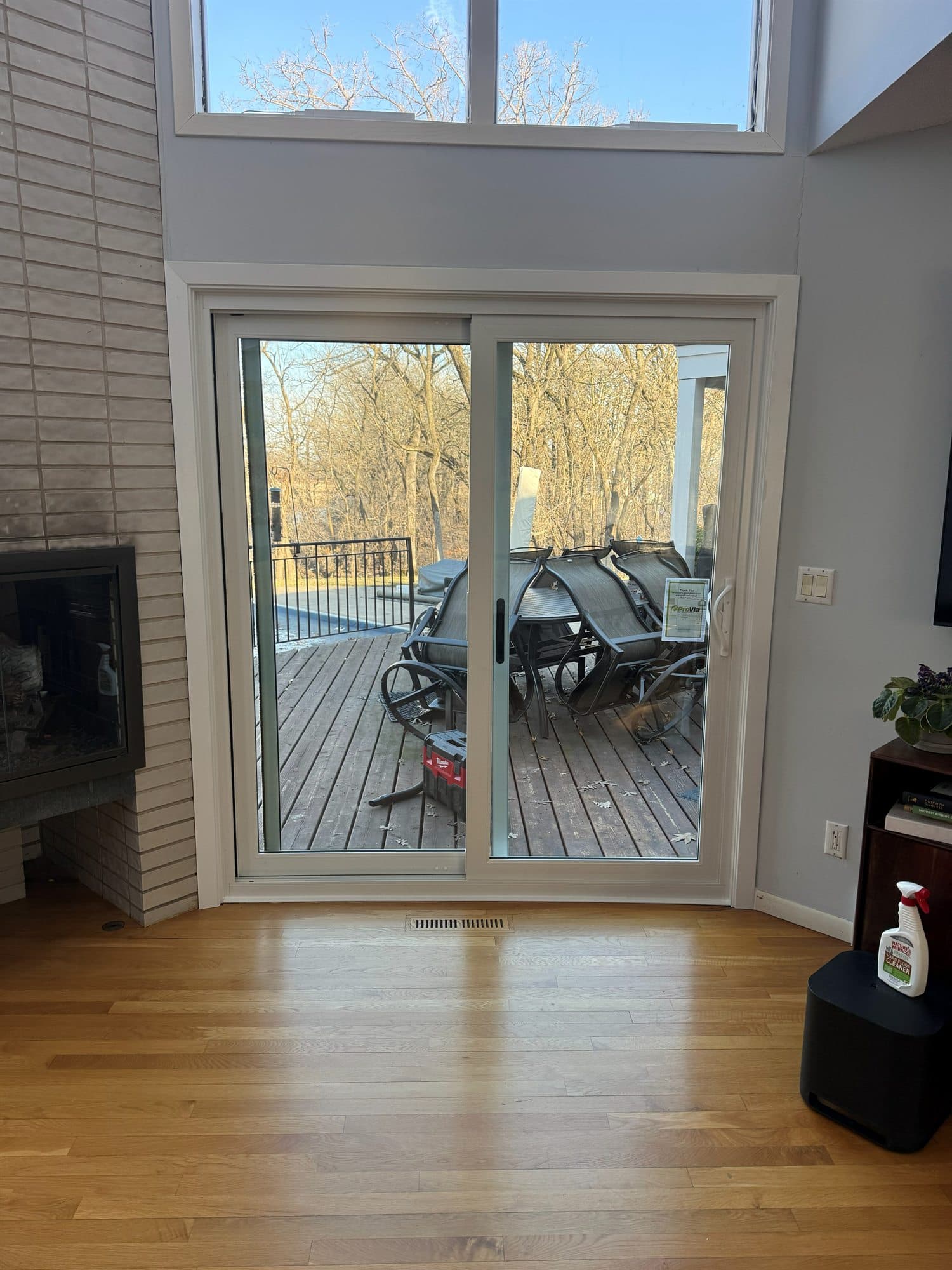
A sliding patio door leaks cold air in four places: the interlock where the panels meet, the sill track under the moving panel, the roller gap, and the edge of the glass. To fix it, order a Northern-zone glass package, a foam-filled or multi-chamber frame, good interlock weatherstripping and a multi-point lock, and have it installed on a sill pan with an interior air seal.
That is the whole recipe. The rest of this guide goes through each leak point, what to look for on the spec sheet before you buy, and what the installer has to do so the door you paid for performs the way its label says. It applies whether we supply the door or you buy it and hire the install.
Where does a sliding patio door leak air?
Hold a hand near a slider on a windy January night and you can map it. The cold comes from:
- The interlock. Where the sliding panel and the fixed panel overlap, a hooked metal or vinyl interlock with pile or fin weatherstripping is the only seal. Worn pile, a panel out of adjustment, or a cheap interlock design leaks along the full height of the door.
- The sill track. The moving panel rides on rollers in a track, and the seal at the bottom is a pile strip or a flexible fin. It fills with grit, wears, and on low-end doors barely touches the panel.
- The head and jamb weatherstrips. Pile or bulb seals at the top and at the strike jamb. These wear less but shrink and harden with age.
- The glass edge. The spacer between the panes is the coldest part of the glass. An aluminum spacer conducts heat to the edge, so frost forms in a band around the perimeter on the coldest nights.
- The frame itself. Hollow vinyl or aluminum without a thermal break conducts cold straight through, and the inside face frosts.
- The rough-opening gap. Behind the trim, a gap that was stuffed with fiberglass or left open moves air around the whole frame regardless of how good the door is.
Why is the glass package the biggest part of the decision?
A patio door is mostly glass, so the glass package sets the U-factor more than anything else. Look for these on the NFRC label or the order sheet:
- Low-E coating. A thin metallic layer that reflects room heat back inside. On a double-pane unit it sits on the inside face of the outer pane (surface 2). Triple-pane units often carry two coatings.
- Argon fill between the panes. Slows heat transfer through the cavity. Krypton is used in thinner cavities, usually on triple-pane doors where the frame cannot take a thick glass unit.
- Double vs triple pane. Triple pane lowers the U-factor and, just as important in Minnesota, raises the temperature of the inside glass so the door is not a cold wall to sit next to and frosts less.
- Warm-edge spacer. A non-metal or thermally improved spacer at the edge of the glass reduces the cold band around the perimeter where condensation and frost start.
What should the frame have for a Minnesota winter?
Frame material is a smaller share of the door than the glass, but it is where the frost shows up first. A hollow vinyl extrusion or an aluminum frame with no thermal break puts a cold strip around the whole opening.
Order sheets use these terms, and they matter:
- Foam-filled frame. Vinyl or fiberglass extrusions with insulating foam injected into the chambers. Raises the inside surface temperature of the frame and cuts frost.
- Multi-chamber extrusion. Vinyl frames with several internal walls. Each chamber is a dead-air pocket. More chambers, warmer frame.
- Thermal break. On aluminum-clad or aluminum frames, a non-conductive strip separating the inside and outside metal. Without one, an aluminum frame will frost on the inside in subzero weather.
- Fiberglass or composite frames. Stiffer than vinyl, so long panels stay straighter and the interlock lines up better over time.
- Interlock design. Ask what the weatherstrip at the interlock is and whether it is replaceable. A deep hooked interlock with dual pile or a fin seal is the sign of a door built for cold.
- Sill design. A sill with a raised interior lip and a thermal break under the track keeps the track from frosting and keeps meltwater from running inside.
Does a multi-point lock make the door tighter?
Yes, and not for security reasons. A single hook latch at handle height pulls the panel into the jamb weatherstrip at one point. Six feet of panel above and below it can sit a fraction off the seal. A multi-point lock throws two or three hooks along the height of the panel, so the whole stile compresses the weatherstrip evenly. On a tall or wide slider the difference is noticeable on a windy night.
The panel also has to be adjusted so it meets the jamb evenly. Roller height adjustment is what lines the panel up; if the top of the panel touches and the bottom does not, no lock will seal it. That adjustment is part of any competent install and a good first thing to check on an existing door.
| Part | Order this | Skip this |
|---|---|---|
| Glass | Double or triple pane, Low-E, argon, warm-edge spacer | Clear double pane, air fill, aluminum spacer |
| Rating | ENERGY STAR Northern; whole-unit U-factor, not center-of-glass | Unlabeled or center-of-glass-only numbers |
| Frame | Foam-filled or multi-chamber; thermal break on aluminum | Hollow vinyl, aluminum with no break |
| Interlock | Deep hook, dual pile or fin, replaceable weatherstrip | Shallow interlock with single pile |
| Lock | Multi-point | Single hook latch |
| Panels | Two panels where the opening allows | Three or four panels for a room that does not need them |
| Sill | Raised interior lip, thermally broken track | Flat aluminum track |
What does the install add?
A slider with a low U-factor in a poorly prepared opening still leaks. The door manufacturer's instructions and ASTM E2112 both put a sill pan under a patio door, and a patio door is where it matters most because the sill is at floor level, gets snow melt off boots and shoes, and is under a track that holds water.
The sill has to be level and fully supported. A patio door sill that is shimmed only at the ends sags in the middle, the rollers fight the track, and the interlock opens up at the top or bottom. We set the pan, then a continuous bed under the sill or solid shims on close centers, then check that the panel meets the jamb evenly along its full height before anything is fastened.
Then the gap: low-expansion foam or backer rod around the head and jambs, never packed hard enough to bow the frame. Inside, a continuous sealant bead between the frame and the drywall or jamb extension is the air seal. Outside, sealant at the jambs and head, the sill left to drain, and a drip cap or head flashing lapped under the siding.
Can I fix the drafts on the slider I already have?
Often, at least partly. In order of effort:
- 1Clean the sill track and vacuum the interlock channel. Grit holds the panel off the seal.
- 2Adjust the rollers so the panel meets the strike jamb evenly top to bottom, then check that the latch pulls it tight.
- 3Replace the pile or fin weatherstrip at the interlock, head, jamb and sill. Most manufacturers sell it by the door model; generic pile comes in standard widths.
- 4Add an exterior bead of sealant at the frame-to-siding joint if the old one is cracked, and check for a drip cap above the door.
- 5If the frame itself frosts on the inside, or the glass has a cold band around the edge every night, the door's glass and frame are the problem and weatherstripping will not fix it.
What JMB Builders does
JMB Builders is a licensed Minnesota residential building contractor (BC809005) based in Zimmerman, installing across the Twin Cities metro with one crew. We install sliding and hinged patio doors from any manufacturer, set on a sill pan, leveled on a supported sill, foamed and sealed inside and out. Send photos of the door and the wall and you have a written quote within one business day; we bring a tape only when the job needs it. Paid by check or direct deposit.
- Sliding patio door installation, labor only, you buy the door — jmbbuildersmn.com/services/doors/sliding-patio-door-labor-only
- JELD-WEN sliding door installation, labor only — jmbbuildersmn.com/services/labor-only/jeld-wen-slider-install-labor-only
- French patio door installation, labor only — jmbbuildersmn.com/services/doors/exterior-french-patio-door-labor-only
- Roller replacement on a slider that drags — jmbbuildersmn.com/services/property-managers/patio-door-roller-replacement
- Related reading: how to choose a patio door for Minnesota winters — jmbbuildersmn.com/blog/choosing-patio-door-minnesota-winters
Frequently asked questions
Why is my sliding glass door so cold in winter?
Usually four things at once: worn weatherstrip at the interlock and sill track, glass with no Low-E coating or gas fill, a hollow or aluminum frame that conducts cold to the inside face, and an uninsulated gap around the frame behind the trim. Cleaning the track, adjusting the rollers and replacing the weatherstrip help. If the frame or glass frosts on the inside, the door itself is the limit.
What U-factor should a patio door have in Minnesota?
Minnesota is in the ENERGY STAR Northern zone. Under the current Version 7.0 criteria, a glass door with more than half its area in glass, which is every patio door, qualifies at a U-factor of 0.26 or lower with a solar heat gain coefficient of 0.40 or lower in the Northern zone. Lower U-factor is better; a triple-pane, foam-filled unit will be well under that number.
Is a triple-pane patio door worth it in Minnesota?
For a large slider in a room you sit in, usually yes. The gain is comfort more than the heating bill: the inside glass surface stays warmer, so the door does not radiate cold at the couch, and edge frost is far less common. Triple-pane panels are heavier, so a stiff frame and good rollers matter more.
Does a sliding patio door need a sill pan?
Yes. The door manufacturer's instructions and the ASTM E2112 installation standard both call for pan flashing under an exterior door, and the residential code requires following those instructions. A patio door sits at floor level under a track that holds meltwater, so it is the opening where a pan matters most. A pan cannot be added without pulling the door.
Are two-panel sliding doors more energy efficient than three or four panels?
Yes, for a given size and glass package. Every extra panel adds an interlock and more track, and those are the two places a slider leaks air. If the opening only needs a two-panel door, order two panels. If you want a wide opening, a hinged French door or a slider with one wide fixed panel leaks less than a four-panel unit.
Can I replace the weatherstripping on a sliding patio door?
On most doors, yes. The pile or fin weatherstrip at the interlock, head, jambs and sill is held in a kerf and slides out; manufacturers sell replacements by door model, and generic pile comes in standard widths. Clean the track and adjust the rollers at the same time, since a panel that sits crooked will not seal against new weatherstrip either.