A new front door pays back three ways: at resale, because buyers judge the house from the curb; in heat, because a foam-core door in a new frame closes one of the biggest air leaks in an older house; and in security, because it brings a new strike and deadbolt. National cost-versus-value reports have ranked steel entry door replacement near the top of all projects for cost recouped for years.
This applies to any Minnesota homeowner with a faded, drafty or dated entry door, selling or not. Here is where the return comes from, what makes the new door tight, and where to put the money so it counts.
Why does a front door return so much at resale?
Buyers form an opinion from the curb, and the entry door is the focal point of the front of the house. Agents tell sellers to refresh or replace a tired front door before listing because the entry sets the expectation for everything inside. A crisp door says the house is looked after; a faded, weathered one plants doubt before the showing starts.
The other reason the return is high is that the project is small. A steel or fiberglass entry door is one of the cheapest exterior projects on a house, so even a modest bump in buyer perception covers most or all of the cost. Cost-versus-value studies compare a project's national average cost against what appraisers and agents say it adds at resale; entry door replacement has sat at or near the top of that list for years, and in some years the report has shown it recouping more than it cost. The exact figure moves year to year and by region, so check the current report for the Minneapolis market before you budget on it.
If you are not selling, you walk through that door every day. Few upgrades give as much daily satisfaction per dollar.
What makes the new door tighter than the old one?
Old entry doors, especially uninsulated wood slabs and hollow doors with worn weatherstripping, leak air all winter and conduct cold straight through the panel. A modern door fixes both. The slab is a polyurethane foam core between fiberglass or steel skins, which insulates several times better than solid wood of the same thickness. On a steel door a thermal break at the edges keeps the outer skin from chilling the inner one, so the inside face does not frost. Any glass in the door is an insulated low-E unit with argon fill, and ENERGY STAR sorts doors by how much glass they carry: solid doors are held to the tightest U-factor, half-lite doors a little looser, full-lite doors looser still.
The frame is the other half. A prehung unit brings compression weatherstripping in a kerf in the stop, an adjustable threshold, a fin sweep on the door bottom and corner seal pads, so the door closes against a fresh seal on all four sides. When it is installed right, with a sill pan under the threshold, low-expansion foam in the gap around the frame and a sealed interior edge, the whole opening stops leaking, not just the door. In a Minnesota winter you feel it in the entryway right away and see it, modestly, on the heating bill.
How does a new door improve security?
Replacement means a new frame with a reinforced strike area, a modern deadbolt and, if you want it, multi-point locking hardware. That is a real jump in security over a decades-old door and a worn jamb. Doors get kicked in at the strike, where the jamb splits, so a new jamb with a long strike plate screwed into the framing matters more than the door skin. Smart locks fit new hardware preps cleanly too.
Which door looks best from the curb?
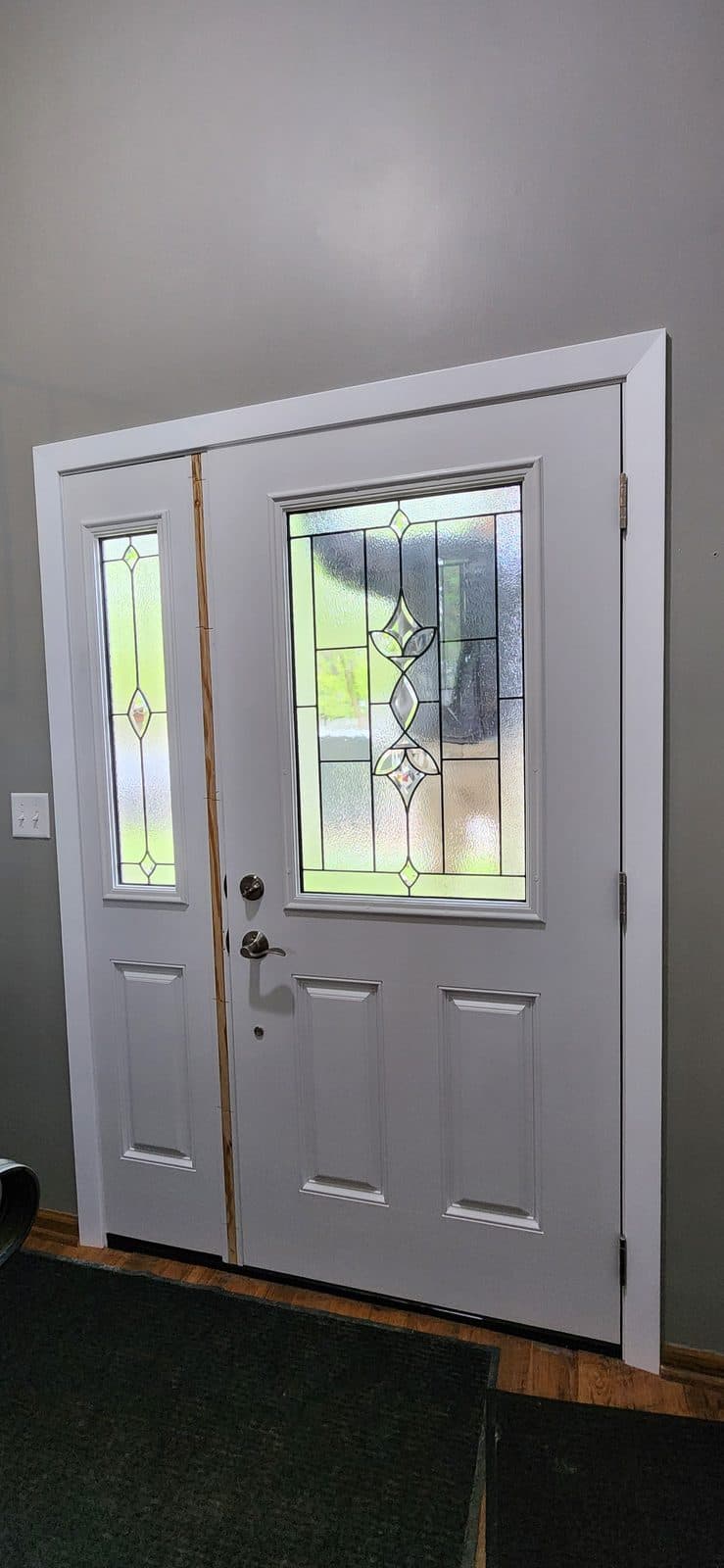
Fiberglass with a wood-grain texture and a gel stain reads as wood from the sidewalk at a fraction of the maintenance. Smooth fiberglass and steel take paint cleanly for a crisp painted look. A glass insert or a pair of sidelites brightens the entry hall and breaks up a wide blank panel, and the glass carries the same low-E insulated package as the door. Match the door style to the house: a craftsman house wants a flat-panel door with a dentil shelf and a small lite up high, a colonial wants raised panels, a rambler takes a plain slab or a modern lite pattern well.
The handleset is the jewelry. It is the part guests and buyers actually touch, and a heavy, well-finished set on a mid-priced door reads better than a bargain set on an expensive one.
Where should the money go?
If you are spending for value, this is the order:
- A quality prehung unit over an expensive slab in an old frame. The frame and weatherstripping are half the upgrade.
- Fiberglass with a stained wood-grain finish gives a high-end look at a mid-range price. Steel with a thermal break is the value pick.
- Sidelites or a glass insert if the entry hall is dark. Daylight changes the room. Ask for low-E insulated glass in the lite.
- Do not skimp on the handleset and deadbolt. It is the part guests and buyers actually touch.
- Budget for a proper install: sill pan, low-expansion foam, flashing, interior air seal, threshold and strike adjustment. A door that swings and latches right is the whole point.
What JMB Builders does
JMB Builders is a licensed Minnesota residential building contractor (BC809005) based in Zimmerman, working across the Twin Cities metro. We measure, set, flash and trim entry doors of any brand, whether we order the door or you bring it home. The door goes in primed, filled and caulked; painting or staining is quoted as its own line, or paint it yourself. Paid by check or direct deposit. Call 763-204-2099 (text) or send photos through the site.
- Labor-only installation of the entry door you bought — jmbbuildersmn.com/services/finish-carpentry/door-installation-labor-only
- Deadbolt and smart lock installation — jmbbuildersmn.com/services/doors/deadbolt-and-smart-lock-install
- Entry door glass insert replacement or a new lite in a solid door — jmbbuildersmn.com/services/doors/exterior-door-glass-insert-replacement
- Front door painting, quoted as a separate line — jmbbuildersmn.com/services/painting/front-door-painting
Frequently asked questions
Does a new front door increase home value?
Yes, more reliably than most projects its size. Remodeling cost-versus-value reports have put steel and fiberglass entry door replacement near the top of the list for years. The door is the first thing a buyer sees, and a new one also means a tighter, more secure entry that shows well at inspection.
How much of the cost of a new front door do you get back?
Cost-versus-value reports have shown entry door replacement recouping most of the project cost at resale, and in some years more than all of it. The exact figure moves year to year and by region. Check the current report for the Minneapolis market before you budget on it.
Is a new front door worth it if I am not selling?
Yes. You walk through it every day, it stops a winter draft in the entry, the foam-core slab stops the cold coming through the panel, and the new frame and deadbolt are a security upgrade. Those benefits start the day it goes in. The resale return is there later if you need it.
Should I replace the slab or the whole door?
The whole prehung unit, in almost every case. The old frame and weatherstripping are usually the reason the door leaks and sticks, and a new slab in an old frame keeps both problems. A slab only makes sense when the frame is square, dry and sound.
Can I add sidelites when I replace my front door?
Yes, if the wall has room. A door with sidelites needs a wider rough opening, which means cutting the wall and setting a new header, so it is priced on its own. A door with a glass insert brings light into the hall without touching the framing, and the insert carries the same low-E insulated glass as a sidelite would.
Does the new door come painted?
Most come primed, some factory-finished. It is installed primed, filled and caulked. Painting or staining is quoted as a separate line, or leave it primed and paint it yourself. Dark colors on a sun-facing door get hot, so check the manufacturer's color guidance first.