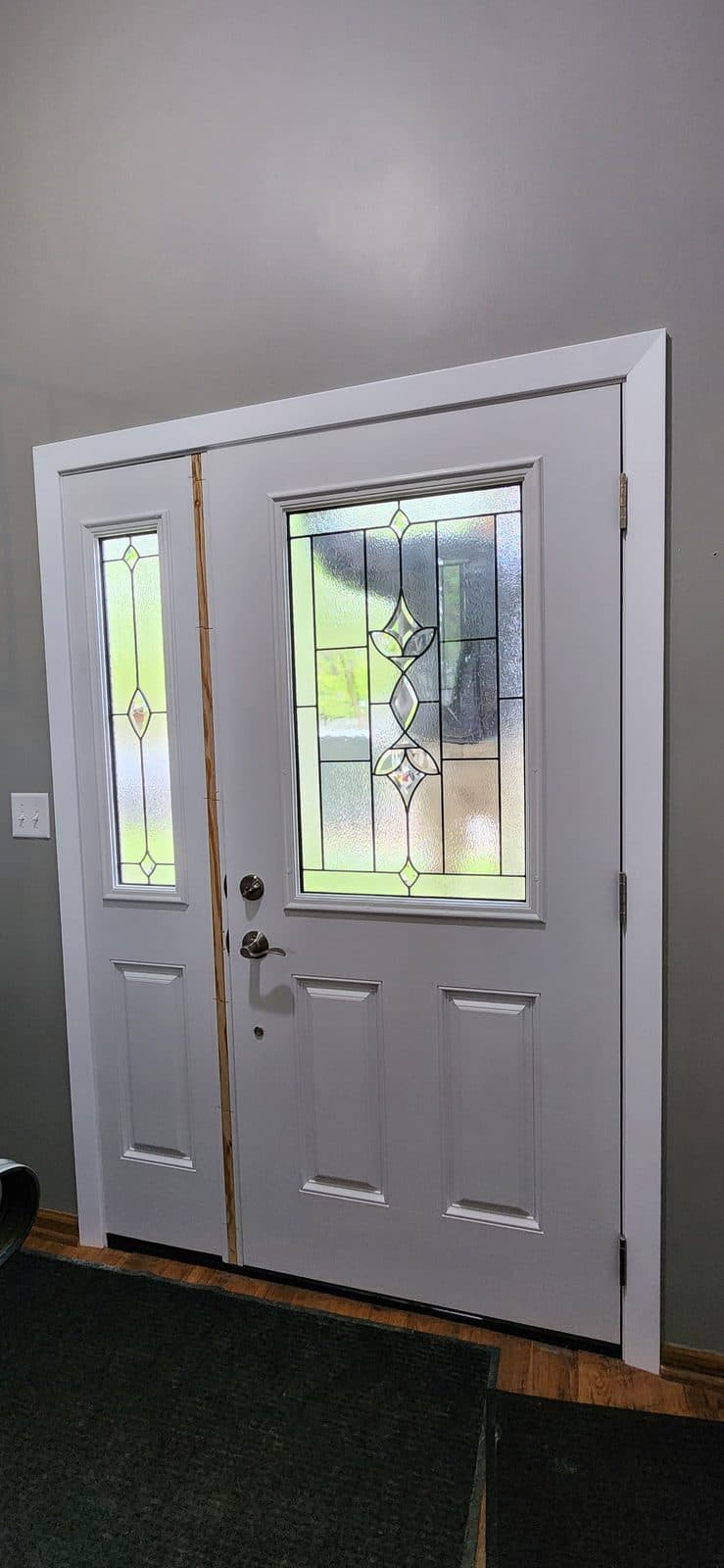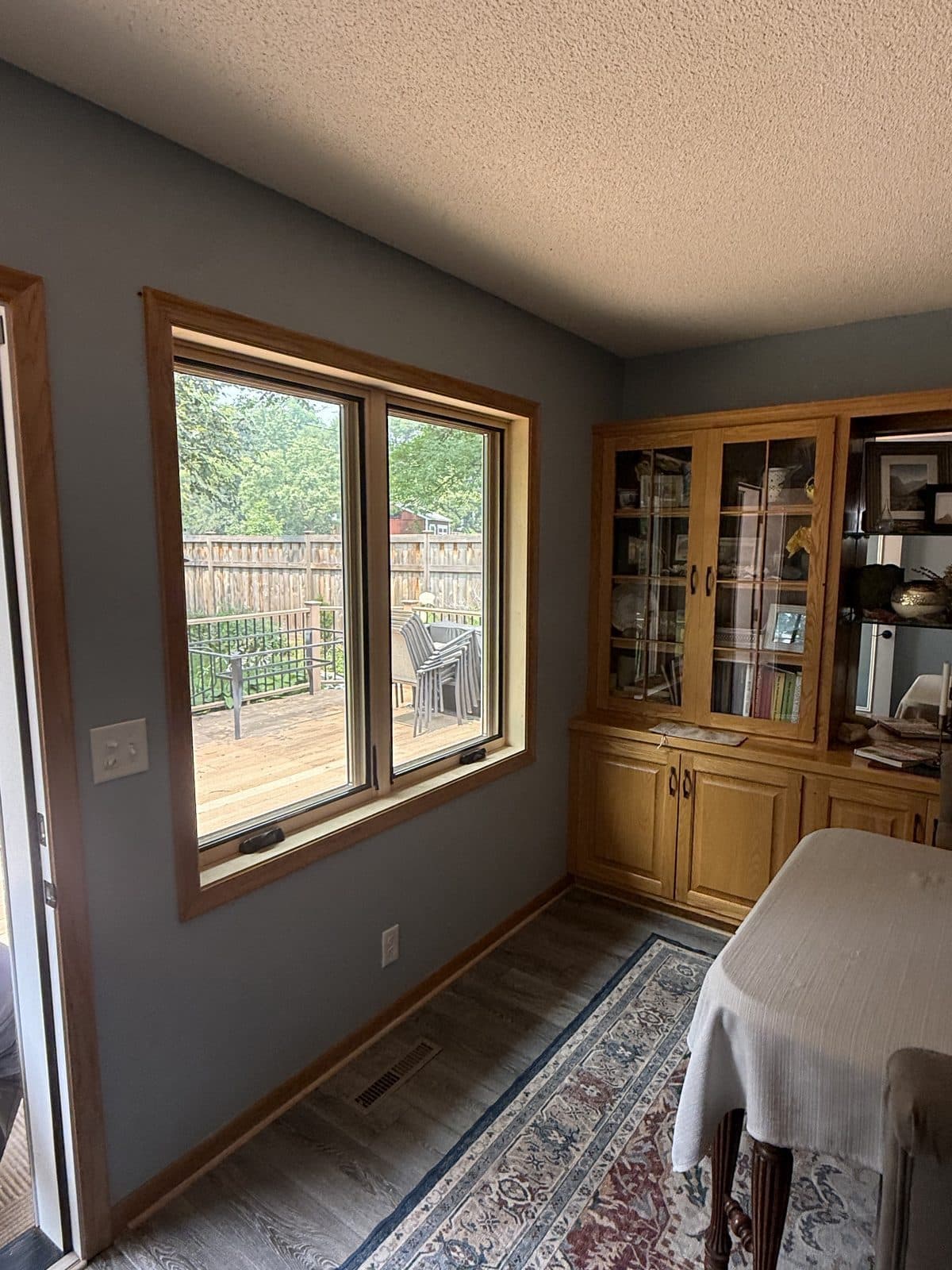
Buy prehung, measure the rough opening and the jamb width, confirm the swing, and order the lockset before the door. Do those four things and a labor-only door install takes a few hours instead of a return trip to the store.
This is the checklist for any Twin Cities homeowner buying an interior or entry door at Menards, Home Depot, a lumberyard or online and hiring the labor. It covers prehung vs. slab, the four measurements, exterior door specifics, how an entry door gets sealed against a Minnesota winter, and who supplies what.
Should you buy a prehung door or a slab?
A prehung door comes hinged in its own jamb with the stop and, on exterior units, the sill and weatherstripping already in place. A slab is just the door panel. Replacing an exterior door? Buy prehung. The old frame almost never seals well enough to keep, and a new sill is half the point in Minnesota.
For interior doors, prehung is still the easier install if the old casing is coming off anyway. Slabs make sense when the jamb and casing are worth keeping, especially in older Minneapolis and St. Paul homes with original stained millwork. A slab install means fitting the door to the opening, mortising hinges and boring for the latch, which is more labor per door.
What do you measure before buying a door?
Grab a tape and a helper. Write everything down and take photos of the door from both sides.
- 1Rough opening. Pull the casing, or measure behind it, and measure the framed opening width and height. A prehung unit needs about 1/2" to 3/4" of play on each side and at the top.
- 2Existing door size. Width and height of the slab itself. Standard interior doors are 24", 28", 30", 32" or 36" wide by 80" tall. Most entry doors are 36" by 80".
- 3Jamb width. Measure the wall thickness from drywall face to drywall face. Most 2x4 walls need a 4-9/16" jamb. 2x6 exterior walls need 6-9/16". Newer homes with thicker sheathing or exterior foam may need a custom jamb or a jamb extension.
- 4Swing and handing. Stand on the outside of the room, or outside the house for an entry door. Hinges on your right and the door swings away from you: right-hand. Hinges on the left, swings away: left-hand. If it swings toward you, it is a right-hand or left-hand reverse.
What do exterior doors need: sill, brickmould and bore?
Entry and service doors carry a few extra choices. The sill should be an adjustable or composite sill, not bare wood, and it needs a solid, level subfloor under it. Order the unit with brickmould attached if your exterior is siding and the old door had it. On stucco or brick the door often goes in without brickmould and gets trimmed differently.
Hardware bore is the hole pattern for the lockset. Most doors come with a 2-1/8" bore and a 2-3/8" or 2-3/4" backset. Confirm the deadbolt bore is included if you want one. Handlesets with a separate deadbolt need 5-1/2" center-to-center spacing on most units. Buy the lockset before the door so the specs match.
The door between the house and an attached garage is a special case. Minnesota's residential code limits it to specific door types, a solid wood door, a solid or honeycomb-core steel door of the required thickness, or a listed fire-rated door. A hollow-core interior door does not qualify. Check the label before you buy.
How is an entry door sealed against a Minnesota winter?
Two things decide whether a new entry door is warm: the door and the install. On the door, look for a foam-filled steel or fiberglass slab, a thermal-break threshold, compression weatherstripping in the jamb, and a corner seal pad at the bottom of each jamb leg. If the door has glass, the NFRC label on it lists the U-factor and solar heat gain coefficient the same way a window label does, and ENERGY STAR certification for the Northern zone is the simple filter. A lower U-factor means less heat loss.
The install is the part most people never see, and it is where a good door gets wasted. When the old door comes out there is a gap of roughly half an inch to an inch between the new jamb and the rough framing on every side. Left empty, or stuffed with fiberglass, that gap is a wind tunnel behind the casing. Fiberglass slows air but does not stop it. The right sequence is:
- 1Sill pan. A formed or flexible pan under the sill so any water that gets past the threshold drains out, not into the subfloor.
- 2Flashing tape. Self-adhesive flashing on the sides and head, lapped so water runs out over the housewrap or siding, with a drip cap at the top on siding.
- 3Shims and fasteners. Shims at the hinges and strike, long screws through the hinge side into the framing, so the door stays plumb when it is slammed.
- 4Low-expansion foam. Window-and-door foam in the gap, not standard gap-filler, which can bow a jamb and bind the door.
- 5Interior air seal. Backer rod pressed into the last of the gap on the room side, then a bead of sealant. This is what actually stops air; the foam is insulation, the sealed joint is the air barrier.
- 6Exterior seal. Sealant between the brickmould and the siding or masonry, leaving the bottom of the sill open so water can drain.
- 7Adjustment. The threshold, sweep and strike adjusted so the weatherstrip compresses evenly and the door latches with a solid click.
Who supplies what on a labor-only door install?
This is how the shopping list splits on a JMB labor-only door install. Other installers may split it differently, so ask up front.
| Item | Homeowner buys | JMB supplies |
|---|---|---|
| Door (prehung or slab) | Yes | — |
| Lockset, deadbolt, hinges for slabs | Yes | — |
| Interior casing and exterior trim | Yes (we tell you the footage and profile) | — |
| Shims, fasteners, low-expansion foam | — | Yes |
| Sill pan and flashing tape (exterior) | — | Yes |
| Caulk and backer rod | — | Yes |
| Paint, stain and finish | Yes, if you paint it yourself | Quoted as a separate line |
| Haul-away of the old door | Ask | Ask — often included |
What should you do before install day?
Have the door in the house, out of the box, at least a day ahead so it acclimates. Clear a path and move furniture near the opening. If the door is stain-grade, finish all six sides before it is hung. A bare door swells in a Minnesota summer and shrinks in January.
Not sure you bought the right door? Send three photos before you order: the product page or box label, the existing door from the hinge side, and the opening. You get a written answer and a reply within one business day.
What JMB Builders does
JMB Builders is a licensed Minnesota residential building contractor (BC809005) based in Zimmerman, working across the Twin Cities metro. Buy the door where you like. One crew pulls the old door, hangs the new one plumb, seals it and cases it. Painting is quoted as a separate line, or leave it primed and paint it yourself. Paid by check or direct deposit. Call 763-250-3621 or send photos through the site.
- Labor-only door installation, priced per door — jmbbuildersmn.com/services/finish-carpentry/door-installation-labor-only
- Interior doors, one or the whole house — jmbbuildersmn.com/services/finish-carpentry/interior-doors
- Install a door bought at Menards — jmbbuildersmn.com/services/doors/install-door-from-menards
- Prehung vs. slab, which to buy — jmbbuildersmn.com/services/doors/prehung-vs-slab-which-to-buy
- How to measure for a replacement door — jmbbuildersmn.com/services/doors/how-to-measure-for-a-replacement-door
- House-to-garage fire door — jmbbuildersmn.com/services/doors/house-to-garage-fire-door
- Trim and door painting, quoted as its own line — jmbbuildersmn.com/services/painting/trim-and-door-painting
- Send three photos and we reply within one business day.
Frequently asked questions
Can you install a door I bought online?
Yes, as long as it arrives undamaged and matches the opening. Send the product page and a photo of the existing door before you order. The jamb width, handing and bore get checked against your opening, and the install is quoted per door.
What does labor-only door installation cost?
Published 2026 cost guides put labor for a straightforward prehung interior door at a few hundred dollars per door including casing. Entry doors run higher because of sill prep, flashing, foam and the interior air seal, plus exterior trim. Send three photos of the opening for a reply within one business day.
How do I tell a left-hand door from a right-hand door?
Stand on the outside of the room, or outside the house for an entry door, and face the door. Hinges on your right with the door swinging away from you is a right-hand door. Hinges on your left, swinging away, is left-hand. If the door swings toward you, it is a reverse swing. When in doubt, send a photo standing in the doorway with the door open.
What jamb width do I need?
Measure the wall thickness from drywall face to drywall face. Most 2x4 interior walls take a 4-9/16" jamb and most 2x6 exterior walls take 6-9/16". Thicker sheathing or exterior foam on newer homes can push an exterior wall past the stock sizes, so measure rather than assume.
Does an entry door need foam and a sill pan?
Yes. The gap between the new jamb and the framing gets low-expansion foam, and the room side gets backer rod and sealant so air cannot move behind the casing. A sill pan under the threshold drains any water that gets past the door. Skip those and a well-built door still drafts and eventually rots the subfloor.
Does the door need to acclimate before it is hung?
Yes. Bring it inside, out of the box, at least a day before the install so it settles to the house's humidity. A stain-grade wood door should be finished on all six sides, including top and bottom edges, before it is hung, or it will swell in summer and shrink in winter.