Replace a Minnesota entry door with a prehung unit, pick fiberglass unless budget says steel, and put the money into the install. Published 2026 estimates put an installed steel door around $1,500–$3,000 and a fiberglass system around $2,500–$5,500 in the Twin Cities. That is the short version for any house with a tired, sticking or drafty front door.
It applies whether the contractor measures and orders the door or you buy it at a store and hire the install. Here are the decisions that matter: prehung or slab, material, how the door insulates, glass, and the install details that separate a 30-year door from a 10-year headache.
Prehung or slab: what are you buying?
A slab is the door panel alone. A prehung unit is the door already hinged in a new frame with weatherstripping and a sill. If the existing frame is square and sound, a slab swap can work. For most replacements a prehung unit is the right call: fresh frame, compression weatherstripping in a kerf in the stop, an adjustable sill, a bottom sweep matched to that sill, and a door that seals the way it was built to.
Old exterior frames are usually why the old door leaked in the first place. The jamb bottoms wick water, the stop is worn where the weatherstrip used to press, and the threshold has settled. A new slab in that frame keeps every one of those problems.
Fiberglass, steel or wood?
Three materials cover nearly every entry door. The right one depends on exposure, budget and the look you want:
- Fiberglass: the all-round choice for Minnesota. Insulates well, will not rust, dent or rot, and wood-grain skins take stain convincingly.
- Steel: the value and security pick. Strong, affordable, insulates well. It can dent, and a bare scratch needs touch-up before it rusts.
- Wood: the real thing, with the heft to match. It needs a protected exposure, a storm door or a deep overhang, and periodic refinishing in this climate.
How does an entry door insulate?
A modern steel or fiberglass entry door is a sandwich: two skins over a core of polyurethane foam, injected or laid in as a slab, with wood or composite stiles and rails around the edge. That foam core is why a foam-core door insulates several times better than a solid wood slab of the same thickness. The rest of the door's performance comes from four places, and a good spec sheet names each one.
- Thermal break. On a steel door, the inner and outer skins must not touch, or cold conducts straight through and the inside face frosts. Look for a wood, composite or polymer thermal break at the edge of the slab, and a thermally broken threshold. Fiberglass skins do not conduct like steel, so this matters less on fiberglass.
- Compression weatherstripping. A foam or bulb weatherstrip pressed into a kerf in the stop, compressed by the door as it closes. Steel doors often add a magnetic strip on the latch side. This is what a new frame gives you that an old one cannot.
- Adjustable threshold and sweep. The sill cap rises and falls on screws so the bottom sweep, a multi-fin vinyl strip on the door bottom, just touches it. Corner seal pads close the gap where the sweep meets the weatherstrip.
- Glass. Every lite is an insulated glass unit, and on a good door it is low-E coated with argon fill. More glass means a higher U-factor, which is why ENERGY STAR sorts doors by glass area.
Which ratings matter on an entry door label?
Entry doors carry an NFRC label like windows do. U-factor is heat loss through the whole unit, frame and glass included, and lower is better. The current ENERGY STAR Version 7.0 criteria sort doors by glass area: a U-factor of 0.17 or lower for an opaque door, 0.23 or lower for a door with up to half its area in glass, and 0.26 or lower for a door with more than half glass or a full lite. Windows in the Northern zone are held to 0.22, so a solid or half-lite entry door outperforms a good window; a full-lite door does not.
SHGC, solar heat gain, matters little on an entry door in Minnesota. Air leakage is the other number worth a look, and lower is better. The label rates the door as it left the factory. A door installed out of square, with the weatherstrip not touching on one side, will never see its rated number, which is the point of the next section.
Should the door have glass, sidelites or a transom?
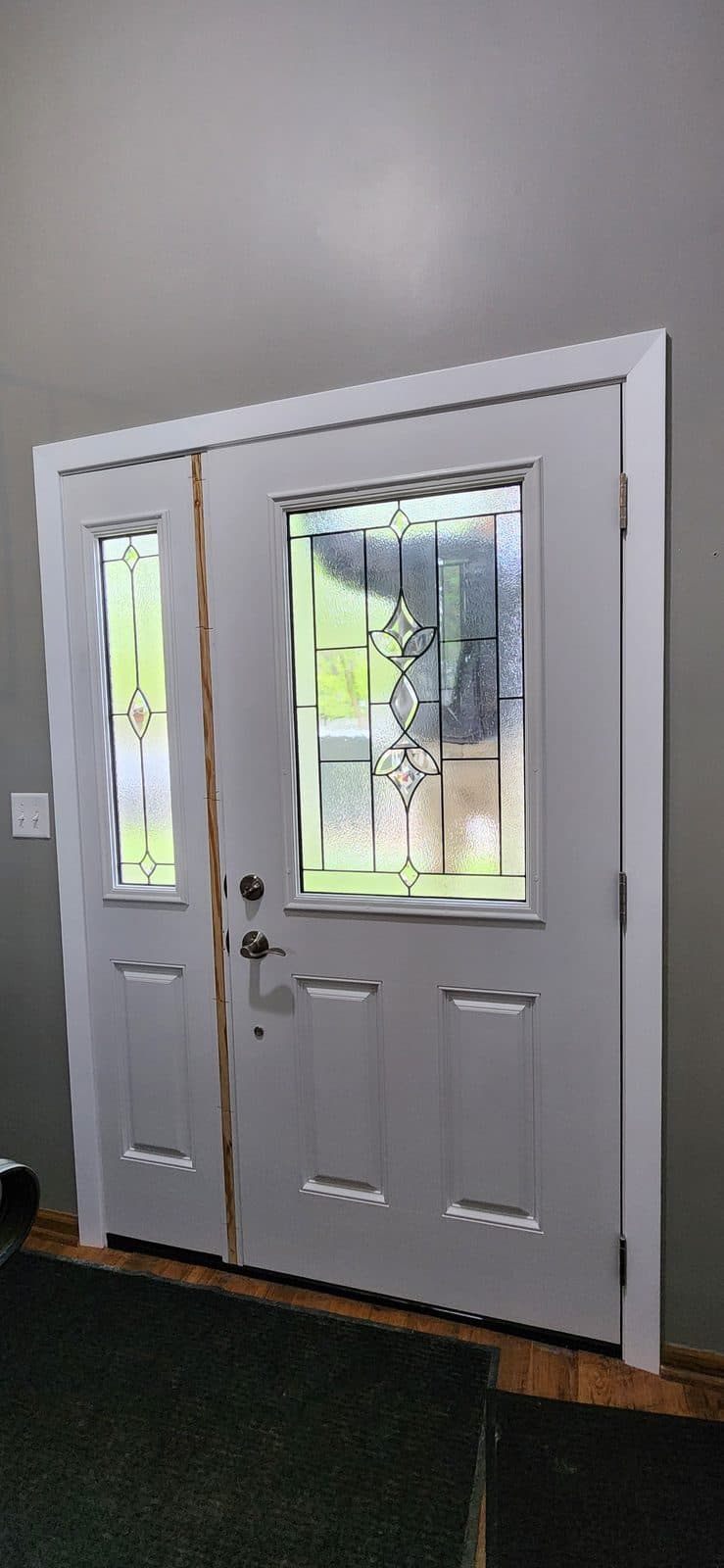
Decorative glass, sidelites and a transom turn a dark entry hall into a bright one. Door glass today is insulated and low-E coated, so light does not cost as much efficiency as it used to, though more glass does insulate less than a solid panel, and a full-lite door lands in the loosest ENERGY STAR tier. Privacy textures, internal blinds and laminated glass are available where the door faces the street closely. Sidelites are their own insulated units in the same frame; ask that they carry the same glass package as the door.
What does a proper entry door install include?
An entry door lives or dies on the install. A proper one means pulling the old unit, checking and repairing the sill area and rough opening, setting a sill pan or pan flashing under the new sill, setting the unit plumb and square so it does not swing open or shut on its own, filling the gap between frame and framing with low-expansion foam, flashing and sealing the exterior against water, sealing the interior edge with backer rod and sealant or a foam bead so warm air cannot reach the framing, adjusting the threshold and strike plates, and trimming inside and out.
The failures installers get called to fix, doors that drag, latch poorly or leak at the sill, trace back to rushed installs, not bad doors. A sill set on bare subfloor with no pan is the most common one, and the rot it causes shows up years later at the jamb bottoms.
What does an entry door cost in the Twin Cities?
Published 2026 cost guides for Minnesota and the national market put an installed steel entry door around $1,500–$3,000, a fiberglass system around $2,500–$5,500, and wood and custom units higher. Those are estimates for planning. Sidelites, transoms and decorative glass add to the material, and rot around the opening is the usual wild card.
Send three photos: the door from outside, from inside, and a close-up of the bottom of the jamb. You hear back from us within one business day, with rot repair priced as its own line if the photos show it.
What JMB Builders does
JMB Builders is a licensed Minnesota residential building contractor (BC809005) based in Zimmerman, working across the Twin Cities metro. One crew from measure to final strike adjustment, installing any brand you buy. New doors go in primed, filled and caulked; painting or staining is quoted as its own line, or leave it primed and paint it yourself. Paid by check or direct deposit. Call 763-204-2099 (text) or send photos through the site.
- Labor-only installation of the entry door you bought — jmbbuildersmn.com/services/finish-carpentry/door-installation-labor-only
- Rotted jamb bottoms on exterior doors — jmbbuildersmn.com/services/doors/exterior-door-jamb-bottom-rot
- Entry door glass insert replacement — jmbbuildersmn.com/services/doors/exterior-door-glass-insert-replacement
- Front door painting, quoted as a separate line — jmbbuildersmn.com/services/painting/front-door-painting
Frequently asked questions
Should I buy a prehung or slab entry door?
Prehung, in almost every case. It comes with a new frame, compression weatherstripping, an adjustable sill and a matched sweep, so the door seals as a system. A slab only makes sense when the existing frame is square, dry and sound and you want to keep it. Rot at the bottom of the old jamb settles the question.
What is the best material for a front door in Minnesota?
Fiberglass for most houses. It does not dent, rust or rot, it insulates well over a foam core and it takes stain to look like wood. Steel is the better buy for a service door, garage entry or rental, as long as it has a thermal break at the edges. Wood belongs under a deep overhang or behind a storm door.
How much does it cost to replace a front door in Minnesota?
Published 2026 estimates for the Twin Cities put a steel entry door installed around $1,500–$3,000 and a fiberglass system around $2,500–$5,500. Wood and custom units cost more. Sidelites, decorative glass and rot repair around the opening are what move the number.
What U-factor should an entry door have?
It depends on the glass. The current ENERGY STAR Version 7.0 criteria are a U-factor of 0.17 or lower for a solid door, 0.23 or lower for a door with up to half its area in glass, and 0.26 or lower for a full-lite door. Lower is better, and the label only holds if the door is installed square with the weatherstrip touching all the way around.
Can I buy the door at Menards or Home Depot and just pay for installation?
Yes. Labor-only entry door installation is priced per door. Before you buy, confirm the handing, the rough opening size, the jamb width for your wall, and whether you want sidelites. Send photos of the existing door and those get checked before you order.
Does a new front door come painted?
Most fiberglass and steel doors come primed, and some series come factory-finished. It is installed primed, filled and caulked. Painting or staining is quoted as a separate line, or leave it primed and paint it yourself.