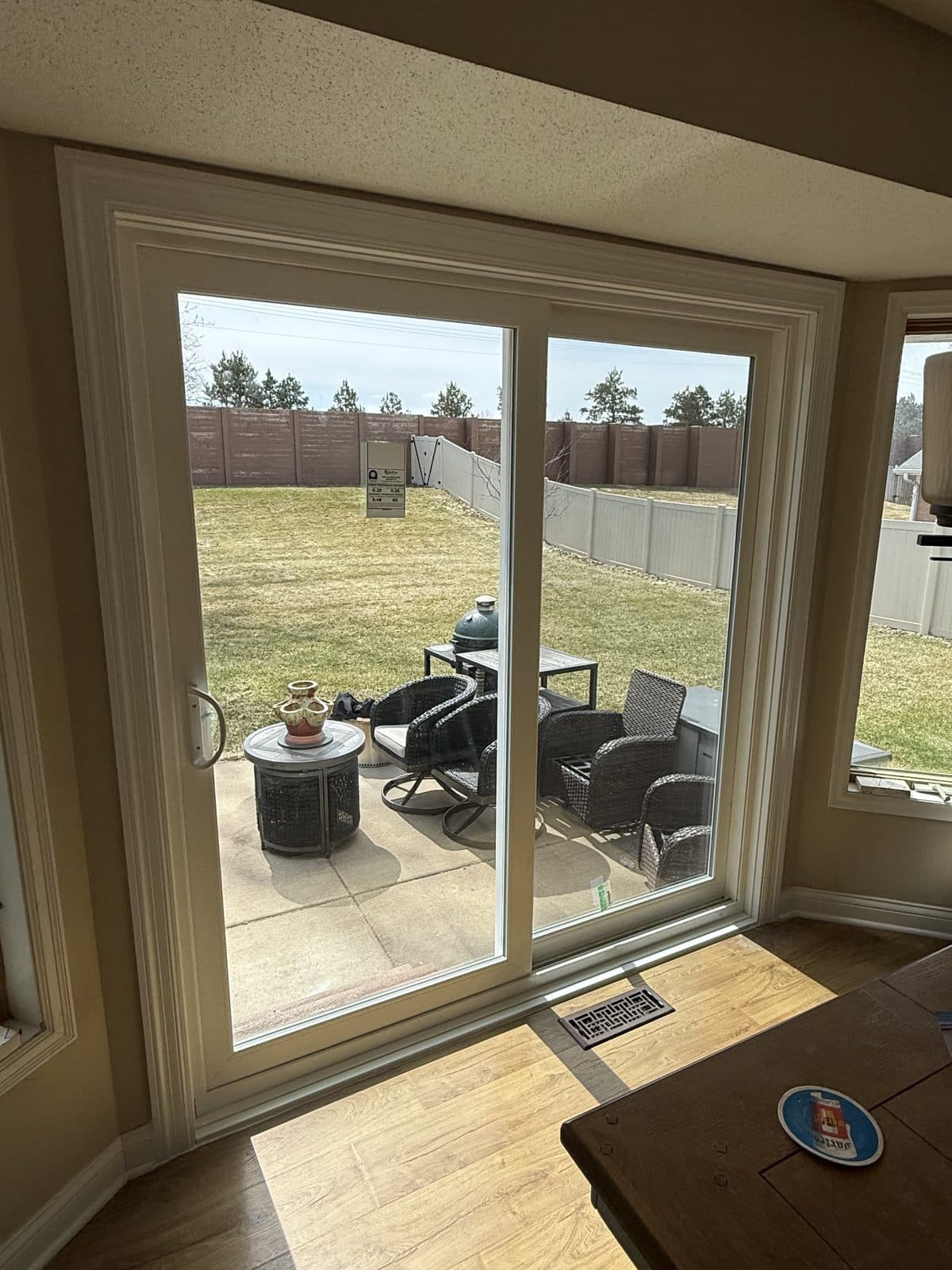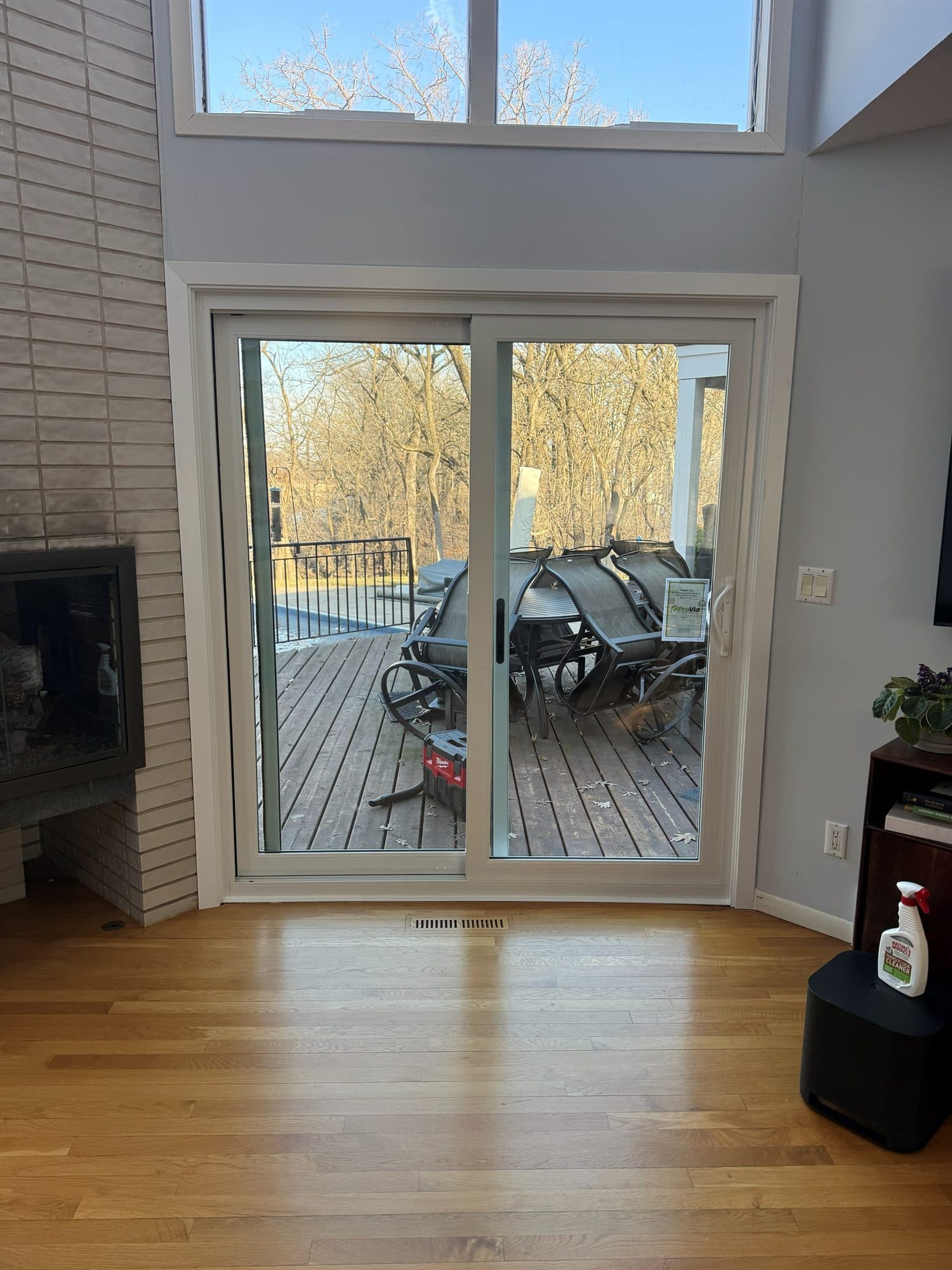
A patio door for a Minnesota winter needs low-E argon glass with a whole-unit U-factor of 0.26 or lower, a thermally broken sill with weep drainage, a reinforced interlock, a multi-point lock, and a frame that moves little with temperature. Buy the glass first, the sill second, the frame third, and put the rest of the budget into the install.
This applies to anyone in the Twin Cities shopping for a slider or French patio door, whether the contractor orders it or you buy it and hire the install. A bargain door shows itself the first cold snap: frosty glass, an icy draft at the latch, water pooling on the track. Here is what to look for instead, and how to read the label.
Which glass package does a patio door need in Minnesota?
Glass is most of a patio door's area, so start there. The Twin Cities are in IECC climate zone 6 and the north of the state is zone 7, so the glass has one main job here: hold heat in. Get dual-pane insulated glass with a low-E coating and argon fill at minimum. The low-E coating is a thin metallic layer, usually on the inside face of the outer pane, that reflects room heat back inside; argon between the panes conducts less heat than air. A warm-edge spacer, the strip that holds the panes apart, shrinks the condensation ring at the glass edge that you would otherwise see every winter morning, and it keeps the seal alive longer through freeze-thaw.
Triple-pane is a real comfort upgrade on north-facing and heavily used doors. The inside pane stays warmer, so there is less radiant chill when you stand or sit near the door and less frost along the bottom edge on a subzero night. It also adds weight, so ask for tandem steel rollers if you choose it.
What U-factor should a patio door have?
Buy the door by the NFRC label. U-factor is the rate of heat loss through the whole unit, glass and frame together, and lower is better. Look for a whole-unit U-factor of 0.26 or lower; that is the current ENERGY STAR Version 7.0 criterion for sliding glass and full-lite doors. Windows in the Northern zone are held to a tighter 0.22, so do not be alarmed that a good patio door reads higher than a good window. There is more frame, more edge and a moving interlock in a patio door.
SHGC, the share of solar heat the glass lets in, matters less here than U-factor. A moderate SHGC on a south or west door gives you some free winter heat. Air leakage is the third number on the label and the one most people skip; lower is better, and it is the fairest measure of how tight the interlock and seals are. Check that the label is for the whole unit, not the center of the glass, which always reads better.
| Package | What you get | Where it makes sense |
|---|---|---|
| Double-pane, clear, air fill | No coating, no gas | Nowhere in Minnesota. Frosts and sweats. |
| Double-pane, low-E, argon, warm-edge spacer | The working minimum. Usually meets 0.26 or lower on a good frame | Most doors, sheltered and south- or west-facing |
| Double-pane, upgraded low-E, argon | Lower U-factor, slightly less light | Exposed doors where triple-pane is out of budget |
| Triple-pane, low-E, argon or krypton | Lowest U-factor, warmest inside glass, heaviest panel | North-facing doors, rooms you sit in near the door |
Which frame material holds up in freeze-thaw?
Multi-chamber or foam-filled vinyl performs well and leads on value; the chambers and foam slow heat flow through the frame the way a foam core does in an entry door. Fiberglass expands and contracts at nearly the rate of the glass, so the seals stay tight for decades, and its stiffness suits a big panel. Wood-clad gives a stained interior with a weather-resistant aluminum or fiberglass exterior and insulates well. Bare aluminum frames with no thermal break belong on a porch in Arizona.
Whatever the frame, ask whether the interlock, where the sliding panels meet, is reinforced and weatherstripped. It is the classic cold-leak point on a cheap door. Good doors use a stiffened interlock with pile weatherstrip on both sides, and compression bulb seals where the panel meets the jamb. The frame depth must also match your wall; a frame built for a 2x4 wall in a 2x6 wall leaves a cold gap the trim has to bridge.
Why do cheap doors fail at the sill first?
The sill takes standing water, melting snow, grit and every footstep. A good door has a stout, thermally broken sill with weep paths so meltwater drains out instead of pooling and freezing in the track. The thermal break is a plastic or composite strip between the outer and inner parts of the sill, so the cold outside does not conduct straight to the track you stand next to. Without it, indoor moisture freezes on the track every cold night.
Ask to see the sill cross-section when comparing doors. A flimsy extrusion and an engineered sill look nothing alike side by side. Ask, too, whether the sill is one piece or has a replaceable track cap, and whether the weep holes have covers to keep wind out.
What hardware seals and locks a patio door?
A multi-point lock pulls the panel snug against the weatherstrip at several heights: better seal and better security in one part. Look for adjustable steel rollers (tandem rollers on a heavy or triple-pane panel), a latch that does not rattle in wind, and an optional foot bolt. Handle feel matters too. You will touch it thousands of times.
Why does the install matter more than the spec sheet?
Every rating above assumes the door is set level, square, flashed and air-sealed. On the job that means a sill pan under the unit so water that gets past the door drains out, shims that set the frame level so the panel does not roll on its own, low-expansion foam in the gap between frame and framing, flashing tape lapped over the housewrap at the jambs and head, backer rod and sealant at the interior edge so warm room air cannot reach the framing, and adjustment so the lock points engage without forcing. A good door installed badly performs worse than a mid-grade door installed right, because the label never measured the gap around the frame.
Send photos of the opening inside and out, and the sill, and say which door you are considering. You hear back from us within one business day, and a note if the door you picked has a weak sill or a wrong frame depth for your wall.
What JMB Builders does
JMB Builders is a licensed Minnesota residential building contractor (BC809005) based in Zimmerman, working across the Twin Cities metro. One crew measures, sets, flashes and trims, whether we order the door or you bring it home, and we install any brand. Paid by check or direct deposit. Call 763-204-2099 (text) or send photos through the site.
- Labor-only installation of a sliding patio door you bought at a store or online — jmbbuildersmn.com/services/doors/sliding-patio-door-labor-only
- Labor-only installation of a hinged French patio door you bought — jmbbuildersmn.com/services/doors/exterior-french-patio-door-labor-only
- How to measure for a replacement door — jmbbuildersmn.com/services/doors/how-to-measure-for-a-replacement-door
- Painting or staining the new trim, quoted as a separate line — jmbbuildersmn.com/services/painting/trim-and-door-painting
Frequently asked questions
What U-factor should a patio door have in Minnesota?
A whole-unit U-factor of 0.26 or lower, with low-E glass and argon fill. That is the current ENERGY STAR Version 7.0 criterion for sliding glass and full-lite doors. Lower is better; triple-pane doors reach lower numbers and keep the inside glass warmer on a subzero night. Windows are held to 0.22 in the Northern zone, so a door reading a little higher than your windows is normal.
Is triple-pane worth it on a patio door?
On a north-facing door or one the family uses all day, yes. The inside glass stays warmer, so less radiant chill near the door and less frost at the bottom edge. On a sheltered, south-facing door, a good double-pane low-E argon unit with a warm-edge spacer does the job for less. Triple-pane panels are heavy, so ask for tandem steel rollers.
Vinyl or fiberglass patio door for cold weather?
Fiberglass if the budget allows. It moves with the glass through the freeze-thaw swing, so the seals stay tight longer, and the stiffer frame suits a big panel. Multi-chamber or foam-filled vinyl is the value pick and performs well when the install is right. Avoid bare aluminum frames with no thermal break.
Why does my patio door track freeze in winter?
Meltwater and condensation collect in a sill with no thermal break and no drainage, then freeze. Cold air getting past a worn interlock adds to it. A new door with a thermally broken sill and weep paths, set on a sill pan, does not do this.
What is a multi-point lock on a patio door?
A lock that throws bolts or hooks into the frame at two or more heights when you turn the handle, instead of one hook at the latch. It pulls the whole edge of the panel tight against the weatherstrip, so it seals better and is much harder to pry.
Can you install a patio door in winter?
Yes. The old door comes out and the new one goes in the same day, one opening, and cold-rated sealants and foam are used. The room loses some heat for a few hours and the new door is tight that night. Winter scheduling is often the most flexible of the year.